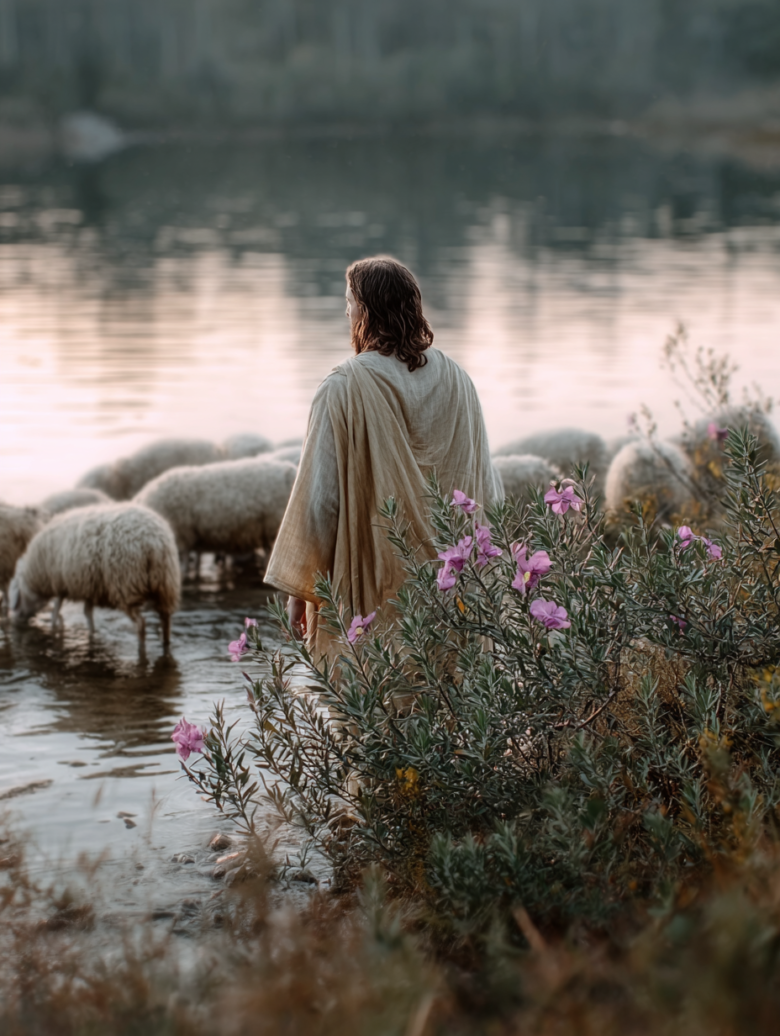
The Gallilean Mystic
Yeshua in His Own World
To encounter Yeshua as he truly lived, we must gently set aside the images that centuries of theology, art, and culture have placed before us. We are invited to meet him not as a distant figure shaped by later traditions, but as an Aramaic-speaking Jewish mystic of first-century Galilee, a son of the land whose life was rooted in prayer, Scripture, and the living presence of Alaha.
Galilee was a rugged landscape of vineyards, olive groves, fishermen, shepherds, and farmers. It was also known for producing charismatic Jewish holy men whose lives were marked not only by devotion to the Torah but by an intimate experience of the Divine. These figures belonged to a stream of Jewish charismatic piety, often associated with the tradition of the Hasidim—the “pious ones.” They were remembered for their compassion, their prayer, their healings, and their unwavering trust that God was not distant but profoundly near.
Among them were figures such as Honi the Circle-Maker, whose bold prayer for rain became legendary, and Hanina ben Dosa, renowned for healing through contemplative prayer. Their authority did not arise from academic learning or religious office, but from lives lived in deep communion with the Divine.
It is within this living spiritual tradition that Yeshua is best understood.
When he addressed God as Abba, he expressed the language of profound intimacy that characterized this stream of Galilean spirituality. God was encountered not as a distant monarch but as the ever-present Source of Life, known through every breath, every prayer, and every act of compassion.
Yeshua’s ministry emerged from this mystical vision.
For this reason, he repeatedly affirmed the Torah rather than rejecting it. “Do not think that I have come to abolish the Law or the Prophets,” he declares in the Gospel of Matthew. “I have not come to abolish them but to fulfill them” (Matthew 5:17).
His challenge was never directed toward the sacred Scriptures themselves, but toward interpretations that could obscure their deepest purpose. Like many Jewish teachers of his time, Yeshua entered into the living tradition of interpretation, continually inviting people beyond external observance into an inner transformation of the heart.
““You have heard that it was said, ‘You shall not commit adultery. But I tell you that anyone who looks at a woman lustfully has already committed adultery with her in his heart.(Matthew 5:27–28).
With these words, Yeshua shifts attention from outward behavior to the hidden movements of consciousness. The true work of the Kingdom begins within. The spiritual journey is not merely about right action but about becoming inwardly aligned with Divine Love.
Perhaps nowhere is the revolutionary nature of Yeshua’s ministry more beautifully revealed than in his relationship with women.
In a culture where women were rarely welcomed into formal theological learning, Yeshua quietly crossed boundaries that few religious teachers of his time would have crossed. Luke tells us that Mary Magdalene, Joanna, Susanna, and many others travelled with him, supporting his ministry and sharing in its mission (Luke 8:1–3). They were not simply observers but active participants in the unfolding of the Kingdom.
This same vision appears in the home of Martha and Mary Magdalene. While Martha (sister og Mary Magdalene) busies herself with the demands of hospitality, Mary sits at Yeshua’s feet. In the first century, this expression was widely recognized as the posture of a disciple receiving the teaching of a rabbi. Rather than sending Mary back to customary expectations, Yeshua affirms her place among his students, declaring that she has “chosen the better part” (Luke 10:42).
This moment reveals one of the most remarkable dimensions of Yeshua’s ministry: the wisdom of the Kingdom is not limited by gender, social status, or religious authority. Every human heart is capable of becoming a sanctuary of Divine Presence.
History helps us encounter Yeshua within his own world. Mysticism invites us to encounter that same living Presence within ourselves.
It is within this world that we encounter Mary Magdalene—not simply as a devoted follower of Yeshua, but as one formed within the same spiritual landscape, whose life became one of the clearest expressions of the mystical vision embodied by her teacher.
Yeshua did not come to establish a religion. He came to awaken the Kingdom of God within the human heart. Yet every movement of the Spirit gives birth to new forms, and what we now call Christianity became one expression of that unfolding mystery.
My invitation is not to leave religion behind, but to journey beneath it—to return to the living well from which it first arose. For beyond every doctrine, every title, every institution, and every tradition, we encounter two human beings wholly surrendered to Divine Union. Before they became symbols of faith, they were lovers of God. Before they became subjects of theology, they were contemplatives. Before they became figures of history, they were mystics. It is here, in the simplicity of their lived experience, that they continue to illuminate the path before us.
Join me in the new Accredited Training Course, The Aramaic Path of the Rose. Here you will learn to pray as Yeshua, the Magdalene and the Christ Family prayer, and you will learn specific shamanic meditations and movement meditations rooted in the mystical essence of the Desert Mystics. CLICK HERE
Ahava,
Ana Otero

Hermosa información siempre que leo sobre Yeshua María Magdalena me baño de luz gracias bendiciones 🙏
Ahava