Where There Is Hatred, Let There Be Love
An Aramaic teaching on relational trust, love, and the purification of the heart
Great mystics speak of true faith as a living relationship. And we are living in profoundly challenging times, where duality, fear, and division seem to be overtaking the human experience.
In Aramaic, the word for faith is haimanuta. Haimanuta does not describe faith as something abstract or distant; it speaks of relational faith. When we have faith in the Divine, the Divine has faith in us. When we have faith in ourselves, our soul responds with faith in us as well. When we place faith in another human being, something in them is called forth to meet that trust. Even the gifts we are here to bring into the world respond to our faith in them. Faith, in this sense, is not one-directional, it is reciprocal, alive, and responsive.
What moves us away from this experience of faith is a duality: fear, separation, and especially hatred. Hatred is not merely an emotion; it behaves like a dark force that enters our field and possesses us. It is no longer about allowing difference or holding complexity, but about rejecting and attacking what is perceived as “other.” The great mystics have always warned us of this. They taught that there is only one kind of impurity that cannot be cleansed with pure water, and that impurity is hatred.
When the Mystics speak of pure water, they are referring to divine presence: God, the angels, love itself. And yet even divine love cannot wash away hatred from the outside. The only force that can dissolve the stain of hatred is the awakening of love from within. Hatred contaminates the soul. One may purify the body through fasting or discipline, but only love can purify the heart.
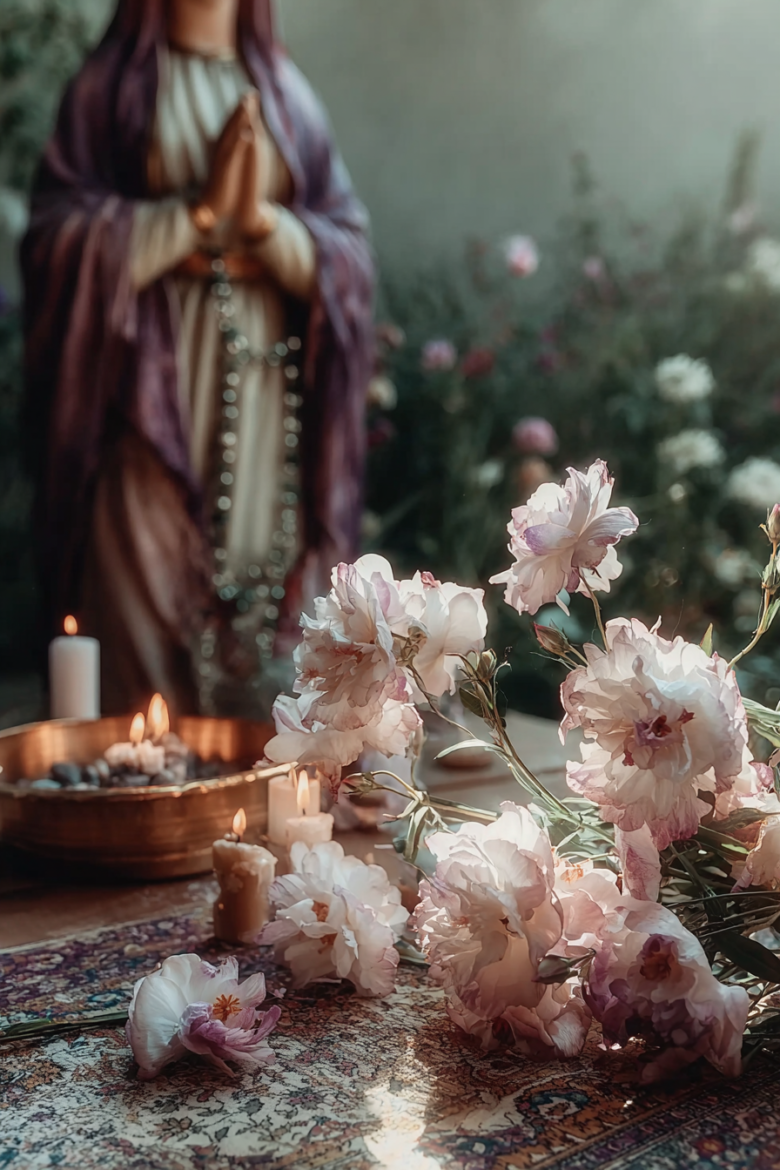
This is why, in times of chaos, whether personal or collective, faith becomes essential. And when the pain feels unbearable, when injustice feels too heavy to hold with an open heart, we are invited to ask for help. We can call upon Divine Mother Mary, Alaha, Mary Magdalene, Yeshua, and the light beings who walk with us and speak to our soul. We can pray simply: Where there is hatred, let there be love.
I remember a story my mother once shared with me. She is profoundly spiritual, and she told me that she experienced hatred only once in her life and this experience even made her doubt her spiritual journey. It made her feel physically ill and brought so much chaos into her world. In response, she began going to the local church every day to pray the rosary persistently until the hatred dissolved. When she slowly started to allow love to dwell within her heart again, absolutely everything shifted in her life. She told me this when I was a little girl, and I never forgot it. I learned that when judgment, aversion, or hatred arise, the way back is always through the heart. And when the heart cannot carry the burden alone, we ask the Divine Mother to help us pray.
“Beware of being bound by a particular belief and rejecting others as unbelief.” Ibn Arabi
When Ibn ʿArabī warns us to “beware of being bound by a particular belief and rejecting others as unbelief,” he is speaking to the same relational understanding of faith that the mystics across traditions have always taught. True faith is not rigid allegiance to an idea about God, but a living openness to how the Divine continues to reveal Itself in relationship. When belief hardens, faith collapses into fear; the heart closes, and difference becomes a threat. But haimanuta is faith that breathes, listens, and responds. It recognizes that when we place trust in the Divine, the Divine entrusts itself to us in ever-new ways, through people who think differently, through circumstances we did not choose, through love that stretches the heart beyond familiarity. To reject the other as “unbelieving” is, in truth, to reject the possibility that God may be meeting us there. Faith, as the mystics understood it, is not about defending certainty, but about remaining intimate with mystery, allowing love to stay awake even when the form of truth challenges us. And it is precisely this kind of relational faith that purifies the heart, dissolves hatred, and restores the soul’s capacity to recognize the Divine wherever it appears.
This is the remembering we are called into now: when we have faith in the Divine Mother, she has faith in us. When we have faith in love, knowing that love is our true essence, love responds with faith in us. And so on! This is haimanuta.: faith as relationship, faith as mutual recognition, faith as a living exchange between heaven and the human heart.
And in returning to this relational faith, we remember who we truly are.
Upcoming Events:
Aramaic Magdalene – Christos Healing Concert February 13th.
For the In Person Event at St. Margaret´s Chapel in Glastonbury, CLICK HERE.
For the LiveStreaming of the Concert (this will be the only concert live streamed in 2026 and replay available), CLICK HERE.
Wishing you a radiant day. Wishing you a blessed Magdalene Shabbat.
Ahava,
Ana Otero

Beautiful Ana. Blessed Shabbat.
Blessings! Ahava
Blessed be – wise kind heart xxx
Ahava!!!