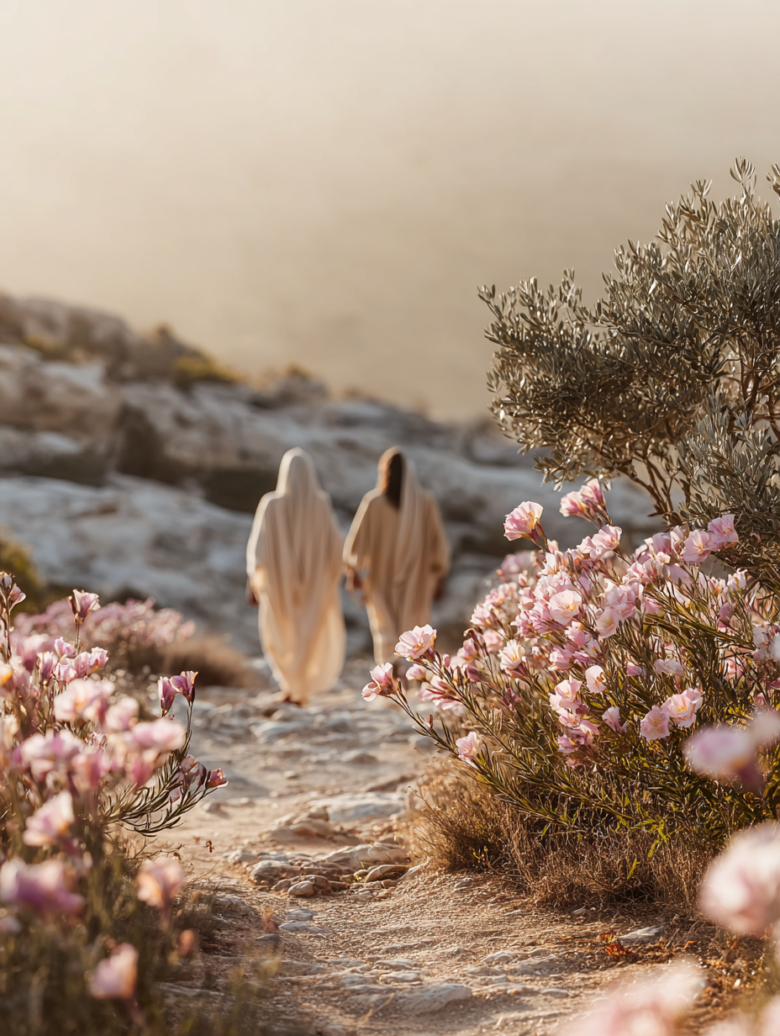
Mary of the Tower
Feminine Presence and Spiritual Authority
Mary Magdalene’s name holds a quiet disruption that continues to speak to the collective long after the historical moment in which she lived. In a world where women were most often identified through male relationship — as daughters, wives, or widows — Mary Magdalene appears in the sacred texts named by a place. She is Mary of Magdala, Mary of Migdal Nunaya, the Tower of the Fish.
This is a symbolic rupture, one that challenges how identity, authority, and belonging have been structured for centuries.
In the time of Yeshua and Mary Magdalene, people were often identified by their town when they were publicly recognizable, economically active, travellers, teachers, or figures of unusual visibility. We see this throughout the Gospel traditions: Yeshua of Nazareth, Joseph of Arimathea, Simon of Cyrene. The naming itself carries significance.
To be named by place rather than possession is to be rooted and sovereign. It reveals an identity formed through origin, presence, and calling, rather than through dependency or legal attachment. In her time, a woman identified by where she came from often signified a degree of economic independence, public recognition, or social autonomy unusual for women of the period.
Mary Magdalene stands in her own lineage of being. Her name tells us that she belongs to the land, to the waters, to the depths that formed her. She is identified by where she comes from and by the quality of perception that place cultivates — depth, intuition, nourishment, and the ability to remain with what is unseen.
Some scholars have suggested that such naming may indicate that Mary Magdalene carried a degree of independence or public identity distinct from traditional domestic definition. Rather than being absorbed into the identity of a husband or male lineage, she appears within the texts as fully individualized and remembered in her own right.
Mystically, the word Migdal or Magdala means tower, elevated place, or stronghold. So “Mary Magdalene” becomes more than simply “Mary from Magdala.” Symbolically, she becomes “Mary of the Tower.”
Within mystical interpretation, the tower represents the elevated soul, the watchtower of consciousness, the keeper of wisdom, and the vessel between Heaven and Earth. Her identity is tied to consciousness, spiritual stature, and inner elevation.
This matters not only for how we understand Mary Magdalene, but for how the collective has been shaped by the absence of such figures. When her identity was later distorted — reduced to sinner, sexualized figure, or repentant accessory — something essential was obscured. The collective lost a model of feminine authority rooted in presence, vocation, spiritual perception, and inner sovereignty. It lost a way of being feminine that stands fully within itself while remaining profoundly relational and openhearted.
The absence of this model has shaped far more than women alone. A spirituality without an autonomous feminine becomes rigid and hierarchical, disconnected from the body, from eros, from grief, from tenderness, and from intuitive knowing. Without Magdalene’s witness, devotion becomes obedience, love becomes morality, and truth becomes doctrine. Her disappearance from the symbolic center created an imbalance that continues to shape institutions, relationships, and inner lives.
Yet this remembrance is equally important for the masculine.Men also carry the inheritance of systems that formed identity through ownership, performance, dominance, suppression, and role. The masculine has long carried the pressure to control in order to belong, to achieve in order to be valued, and to remain armored in order to feel safe. When the feminine is restored in her sovereignty, the masculine is also liberated into a deeper form of relationship.
Mary Magdalene reveals that love deepens when both men and women remain fully present within themselves. She teaches that intimacy flourishes through freedom, presence, and mutual recognition. Her witness allows the masculine to soften while remaining grounded, to feel deeply while remaining strong, to protect through presence rather than control, and to enter relationship through authenticity rather than domination.
This is why Magdalene and Christos together become so important symbolically. Their union is founded upon recognition. Presence meets presence. Consciousness meets consciousness. Love becomes a field of awakening and sacred reciprocity.
The fact that Mary Magdalene is named repeatedly, independently, and consistently across Gospel traditions is itself historically significant. Many women within the Gospel narratives remain unnamed entirely, yet Mary Magdalene is remembered, individualized, and preserved within collective memory.
She is witness of resurrection, disciple, transmitter, and central feminine presence within the Christ movement.
This suggests that the earliest communities remembered her as a figure of profound spiritual importance.
Mary Magdalene returns in our time as a remembrance rising from within the collective itself. In an era where inherited roles are dissolving and identities based solely on gender, function or status no longer sustain the soul, her presence reveals another way. She shows us that it is possible to be in deep relationship while remaining rooted within oneself, to love through presence, to serve through devotion, and to carry authority through embodiment.
Her way is rooted, embodied, relational, and fully alive.
When a woman is named by who she is rather than by ownership, the body becomes sacred again.Yet this teaching is not only for women. It is for men as well. It is a remembrance of something fundamentally human.
We are not defined by who possesses us, controls us, validates us, or claims us. We belong neither to ownership nor to domination. We belong first to our own soul and ultimately to the Divine from which we arise.
When we remember this, the body becomes sacred again—not as an object to be controlled, but as a living temple of Presence. Life itself becomes sacred. The land beneath our feet becomes more than geography; it becomes lineage, relationship, and belonging. Our calling becomes more than a profession or role; it becomes the expression of the soul’s unique covenant with life.
Authority also changes. It no longer comes from status, title, power, or the approval of others. True authority arises through presence. It emerges from integrity, embodiment, wisdom, and the willingness to stand rooted in one’s own being.
This is one of the gifts hidden within the name of Mary Magdalene. She reminds us that identity can arise from essence rather than ownership, from purpose rather than possession, from calling rather than control.
When we remember this, we remember that we belong to the living current of our soul.
And from this space, something profound is restored.
We no longer seek permission to exist.
We no longer derive our worth from what we own, whom we serve, or who recognizes us.
We stand rooted in the sacred ground of our own being.
For in the end, the soul was never meant to belong to another’s possession, but to become a living expression of the Divine Presence that called it into being.
Upcoming Events
Magdalene Christos Shabbat. Monthly Online Gathering May 29th. Click Here
Mother Mary 9 Day Devotional Journey: 9 Dimensions of Light Conception and the Covenant of Our Incarnation. Online Journey starts May 31st. Click Here.
My team has finally included the Kabbalistic Astrology Workshops from the former online platform to our new Online Desert Rose Sanctuary. So many of you have been asking me about this and so I am sharing the link! CLICK HERE
Sarah Tamar Blue Rose Accredited Training is open. Click here
Magdalene Holy Gathering In Glastonbury. In Person Retreat July 22, 23, 24. Click Here
Sending love to all of you.
AHAVA,
Ana Otero
