Black Madonna
Our Lady of Suyapa
Our Lady of Suyapa is the Patroness of Honduras, and her feast day is celebrated on February 3.
Her miraculous discovery was by the farm worker Alejandro Colindres, at the end of January or the beginning of February in 1747.
Suyapa is located southeast of Tegucigalpa, the capital of the country, about eight kilometers away. Its name comes from Coyapa, an indigenous word meaning “in the water of the palms.” Nearby stands Mount Pilingüín, always dressed in green thanks to its pine foliage.
One afternoon, a farmer named Alejandro Colindres was walking down the path. With him was Lorenzo Martínez, an eight-year-old boy. They were returning from working in the cornfield, where they had been harvesting maize. The sun was setting behind the hills, and since the day had been intense, they decided to spend the night there.
When Alejandro lay down on the ground, he felt something preventing him from resting comfortably. In the darkness, he grabbed the object and threw it away. But when he lay down again, he felt the same discomfort in the same place. This time he did not throw it away but kept it in his bag. The next day he discovered that the mysterious object was a small statue of Our Lady carved in cedar wood. It measured about six and a half centimeters high, had a dark complexion, and her hands were joined over her chest.
Alejandro took the statue to the family altar in his mother’s home. The family had deep religious devotion. They placed the image on a small table, decorated with fresh flowers renewed daily. They had great devotion to the Immaculate. Later, they moved the image to a small room arranged as a chapel. For more than twenty years, they offered simple and sincere family devotion to her in the Colindres home. They visited her often, offered their work, and entrusted their concerns and needs to her.
The villagers also loved her dearly. When someone fell ill, they would bring the image to the person’s home so that the Virgin could “visit” the sick. One day, Don José de Zelaya, an important military man and owner of the nearby estate “El Trapiche,” became ill. Isabel Colindres heard of his illness and sent word that, if he wished, she could send the image of her Virgin. Don José agreed, and they brought the Virgin in a kind of procession. Upon her arrival, the sick man, devout and contrite, asked for healing and promised to build her a hermitage in return. Three days later, he felt cured of his illness. This occurred in 1768.
Nearly ten years passed before Don José could fulfill his promise. Finally, on November 28, 1777, the ecclesiastical council gave permission to build a chapel on his estate so that Mass could be celebrated there. The temple was built with adobe and pink stone from nearby quarries between 1777 and 1780, and it remains the home of the “little dark one” to this day. The hermitage was blessed in 1780.
As pilgrims increased, continuous renovations became necessary. Due to its age, the Hermitage is of great historical importance for Honduras. Inside are colonial-era altarpieces that have remained since its construction.
Our Lady of Suyapa was named National Patroness of Honduras by Pope Pius XII in 1925, and her feast is celebrated on February 3. The small statue wears a golden crown adorned with precious stones.
Due to the growing number of pilgrims, in 1943 construction of a larger cathedral began. The sanctuary construction began in 1954, becoming one of the largest temples in Central America. The image was later transferred there.
For over two centuries, countless pilgrims have visited the Sanctuary of Our Lady of Suyapa. Pope John Paul II celebrated Mass there in 1983. The sanctuary was officially inaugurated in 2005, and in 2015 Pope Francis elevated it to a Minor Basilica.
Today, the statue is kept in the Basilica of Suyapa and is taken on pilgrimage tours across Honduras each February. Many thousands of pilgrims from Central America visit her on February 3.
Our Lady of Suyapa is the Virgin of the Honduran people and a symbol of peace for many in Central America and beyond.
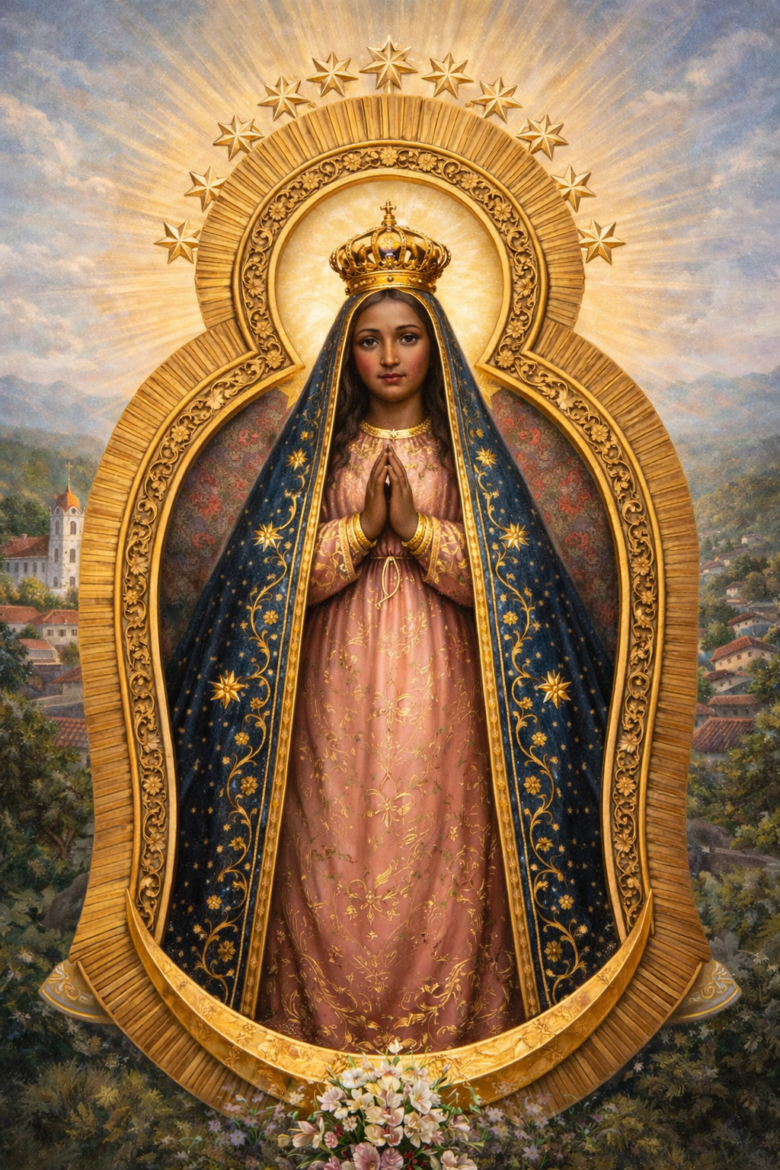
Description of the Image
The image of Our Lady of Suyapa is a small cedar wood sculpture measuring six and a half centimeters. She has a dark complexion, an oval face, straight nose, small mouth, and merciful eyes and has dark skin.
Her hair falls on both sides of her face. Her small hands are gently joined over her chest. She wears a pink tunic covered by a dark mantle adorned with twelve golden stars. Silver rays surround the image, and twelve stars circle her head.
Mystical Meaning of the Image
The Key Shape
The golden form that surrounds her — often seen as a key-shaped mandorla — represents Mary as the Key of Mercy and the Gate of the Heart. She is not shown as power in a worldly sense, but as the one who opens what is closed:
• the closed heart
• locked grief
• blocked destiny
• spiritual blindness
She is the threshold through which grace enters. Mystically she is Porta Coeli — the Gate of Heaven — because through her consent, the Divine entered the world. The key reminds us that what is opened through love cannot be forced, only received.
Her Blackness — The Black Madonna Mystery
Her dark complexion carries profound mystical symbolism beyond ethnicity.
The Black Madonna represents:
• the fertile womb of creation
• hidden wisdom
• the Divine present in the unseen
• the mystery of God dwelling in matter
• light gestating in darkness
Black is the color of potential, like the soil where seeds germinate, like the night sky where stars are born. She is the Holy Darkness from which light emerges.
The Colors of Her Garments
Blue mantle
Represents the heavens, divine protection, and the vastness of spiritual consciousness.
Pink tunic
Symbolizes the heart — human tenderness, maternal compassion, embodied love.
Gold
Divine radiance, the light of God shining through matter, the glory hidden in humility.
Together these colors reveal her as:
Heaven wrapped around the human heart, crowned with divine light.
The Twelve Stars
The twelve stars signify:
• fullness of divine order
• cosmic harmony
• the twelve tribes / apostles /zodiacal frequencies
• humanity gathered in wholeness
She is shown as the Mother of the renewed creation — the cosmos held in compassion.
Why She Appeared Small
Her tiny size teaches:
The doorway to the Infinite is often hidden in what the world overlooks.
God enters quietly. Grace comes in humble forms. The key to the Kingdom is not magnitude — it is receptivity.
Water of the Palms — The Mystical Meaning
The place where Our Lady of Suyapa was found is not only geographical, it is symbolic. The very name Suyapa, “water of the palms,” carries a spiritual teaching hidden in plain sight.
Water in the language of the soul represents the unseen depths: the unconscious, the womb of life, purification, emotional healing, and the place where Spirit moves before form appears. In Marian mysticism, water is the feminine matrix of grace — living mercy that washes, softens, and renews. When Mary appears in “water,” she is revealing herself as the Mother who emerges from the place where life begins, from the hidden source where transformation is already taking place.
Palms add another layer of meaning. Throughout spiritual tradition, the palm symbolizes victory over suffering, resilience that bends without breaking, the oasis in the desert, nourishment in arid lands, and life where survival seems unlikely. A palm grows where water lies hidden beneath the surface. It is a sign that life is secretly sustained, even in harsh and barren conditions.
Together, “Water of the Palms” is a spiritual metaphor: hidden life, inner mercy, and quiet strength. It speaks of grace rising from unseen depths, divine tenderness present in human struggle, spiritual life sustained even in poverty or hardship, and the oasis of the soul during dry seasons of life.
This imagery is deeply connected to the mystery of the Black Madonna. She often appears in caves, grottos, forests, springs, and mountains, places that symbolize the womb of the earth, where the visible world meets the hidden interior. Suyapa, “water of the palms,” is such a place: the womb within the desert, the oasis of the heart.
Mystically, this becomes a map of the soul. We all walk through deserts, seasons of loss, doubt, fatigue, or spiritual dryness. Yet beneath the surface of our lives, there is an underground spring. Grace continues to flow where we cannot see it.
Mary appears there.
She is the hidden grace, the quiet endurance, the mothering presence that keeps us spiritually alive when strength feels gone. She is the inner oasis of the heart, the mercy that sustains us from below.
That is why she is found in the water of the palms.
Our Lady of Suyapa is prayed to as a Mother who draws near in life’s most vulnerable moments. People turn to her in times of illness, emotional hardship, family need, and hidden struggles of the heart. She is associated with gentle healing, quiet protection, endurance through difficulty, and grace that sustains when strength feels low.
As a Black Madonna who appeared in the “water of the palms,” she represents the hidden mercy that flows beneath the surface of our lives, the inner oasis that keeps the soul alive in dry seasons. She is the one who walks with the weary, watches over homes, and brings peace in times of uncertainty.
She is the Mother who meets us where we are, especially where we feel most unseen.
Blessed are you Virgen de Suyapa!!!
Registration is now open for:
The Magdalene Holy Gathering in Glastonbury July 22, 23, 24.
CLICK HERE FOR MORE INFORMATION.
AHAVA,
Ana Otero
