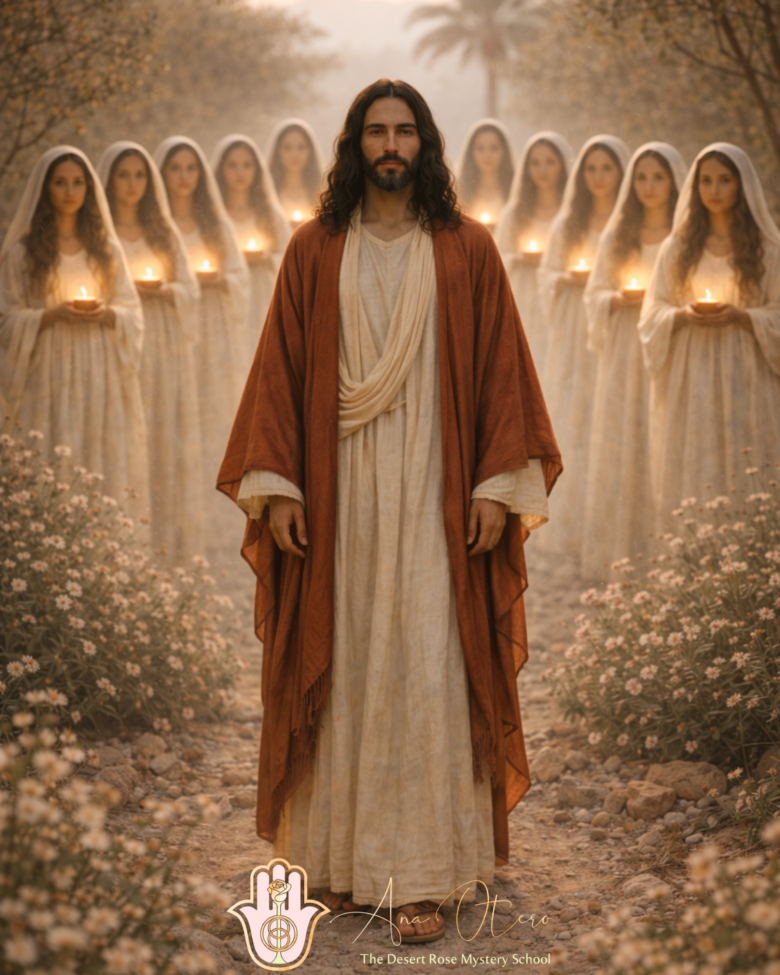
Yeshua & the Parable of the Ten Virgins
The Mystery of the Oil and the Readiness for Divine Union
After Palm Sunday, during Holy Week, sacred scripture tells us that Yeshua returned to the Temple and taught openly. These were his final transmissions before the crucifixion, offered at the threshold between life and death, just before the great passage into resurrection.
Among these teachings, he offers the parable of the ten virgins.
Five are wise, and five are foolish. There are lamps, there is oil, and there is a wedding chamber. When read superficially, it may appear as a simple moral teaching, yet within the language of the mysteries, these elements are precise symbols pointing toward the deepest initiatory path, the path of the Bridal Chamber, the path of Divine Union, and the inner preparation required to enter it.
In the mystical understanding, the “virgins” are not defined by gender, but by state of being. A virgin is one who is undivided, one whose inner life is not scattered across fragmentation, but gathered into coherence. It is the soul that has become whole enough to enter union, the soul that is no longer divided within itself. In this sense, the parable does not describe ten individuals, but a state of consciousness within us.
The lamp represents the vessel, the structure of our being, the life we carry, the form through which light can be expressed. Yet the lamp alone is not enough. A vessel may exist, a life may be lived, a path may even be followed, but without oil, the flame cannot remain. The lamp without oil may appear complete, but it cannot sustain illumination.
And the oil, this is the essence of the teaching.
The oil is chrism, the inner anointing. It is Hūbā, the sacred flame of divine desire that lives within the soul as the movement of love drawing us back into union with what we already are. It is the substance that is cultivated through devotion, purification, surrender, and lived union. It is not something acquired externally, but something refined internally over time. It is what allows the light not only to be ignited, but to remain.
This is the distinction that Yeshua is revealing. It is not a division between good and bad, nor between worthy and unworthy, but between those who have cultivated inner substance and those who have not. The wise carry oil; the foolish carry only the form. They have the lamp, but not the living flame. They have the structure of spirituality, but not its embodied fire.
When the moment arrives—when the Bridegroom comes at midnight, in the hour of the unknown, at the threshold between worlds—only those who have oil are able to enter. This moment is not bound by chronological time, but by readiness of being. It is the moment in which Divine Union becomes available, and the soul is either capable of sustaining it or not.
Because Divine Union is not entered through longing alone. It is entered through readiness.
The oil cannot be borrowed, nor transferred, nor given in that moment. It must be cultivated within the soul itself. Just as one cannot borrow another’s consciousness, another’s embodiment, or another’s union, one cannot borrow the oil. Each soul must become capable of carrying its own flame.
The Bridal Chamber is not a place one is granted access to; it is a state one becomes capable of inhabiting. It is entered when the inner life has been refined to the point where the vessel is receptive and the flame is alive and stable.
This teaching is given during Holy Week for a reason. What follows is not simply the crucifixion, but the full revelation of Divine Union through the Paschal mystery, the passage through death into resurrection, the offering of the self, and the embodiment of a consciousness that no longer lives in separation.
This is where the teaching of Eucharistic consciousness becomes essential.
The Eucharist is not merely a ritual confined to a moment of bread and wine; it is a state of being in which life itself is lived as offering, reception, and participation in Divine Union. It is the awareness that what is given has already been received, and that we are not separate observers of the Divine, but active participants within it. To live Eucharistically is to embody unity so deeply that every act becomes communion, every breath becomes exchange, and every moment becomes an expression of union.
From this perspective, the oil in the parable can be understood as the capacity to sustain Eucharistic consciousness. It is the inner readiness to not only receive the Divine, but to remain in that state of participation, to live from it, and to express it. Without this cultivated presence, even the most profound moments of grace cannot be held.
Mary Magdalene stands at the center of this mystery.
She prepared the vessel, carried the flame, and recognized the Bridegroom because she is already was living in union. Her recognition of the resurrected Christ is the natural consequence of her consciousness. She embodies Eucharistic awareness: the capacity to perceive, receive, and participate in the Divine as living presence.
The parable of the 10 Virgins is a mirror during Holy Week, and Yeshua asks us:
Are you carrying oil?
Have you cultivated the inner fire that allows you not only to seek the Divine, but to remain in the Divine?
Is your devotion something you visit occasionally, or something that has become the ground of your life?
When the moment of union arrives, will your vessel be ready to receive it, or will you still be searching for what must be prepared within you?
Have you done the inner work required to sustain the flame, or are you relying on inspiration that comes and goes?
What within you still fragments under pressure, and what within you is becoming steady, clear, and whole?
Are you waiting for the Divine to arrive, or are you becoming the place where it can dwell?
What would it mean, in your life, to stop seeking and begin embodying?
Aramaic Mantra — The Oil Within
הוּבָּא דְּאָלָהָא
Hūbā d’Alaha
The Sacred Flame of Divine Love
Now is the moment to cultivate the oil within you, because the life you are asking for will require the version of you that is ready to hold it.
(You can read the full text from the Gospels Below).
Magdalene – Christos Easter Mass April 5th. Community Gatherings are open and free of charge, the only exchange asked for is respect towards teachings and participants. CLICK HERE TO REGISTER.
IMPORTANT NOTICE: The Desert Rose Mystery School is closed for Holy Week. We will be reading emails once a day and we may take 2-4 days to answer.
Ahava,
Ana Otero
Gospel of Matthew (25:1–13):
“Then the kingdom of heaven shall be likened to ten virgins who took their lamps and went out to meet the bridegroom.
Now five of them were wise, and five were foolish.
Those who were foolish took their lamps and took no oil with them,
but the wise took oil in their vessels with their lamps.But while the bridegroom was delayed, they all slumbered and slept.
And at midnight a cry was heard:
‘Behold, the bridegroom is coming; go out to meet him!’Then all those virgins arose and trimmed their lamps.
And the foolish said to the wise,
‘Give us some of your oil, for our lamps are going out.’But the wise answered, saying,
‘No, lest there should not be enough for us and you;
but go rather to those who sell, and buy for yourselves.’And while they went to buy, the bridegroom came,
and those who were ready went in with him to the wedding;
and the door was shut.Afterward the other virgins came also, saying,
‘Lord, Lord, open to us!’But he answered and said,
‘Assuredly, I say to you, I do not know you.’Watch therefore, for you know neither the day nor the hour in which the Son of Man is coming.”

And in that hour the five wise virgins became light bearers of His countanence.
Ahava!
¿Qué significaría, en tu vida, dejar de buscar y comenzar a encarnar? todo
Precioso…AHAVA