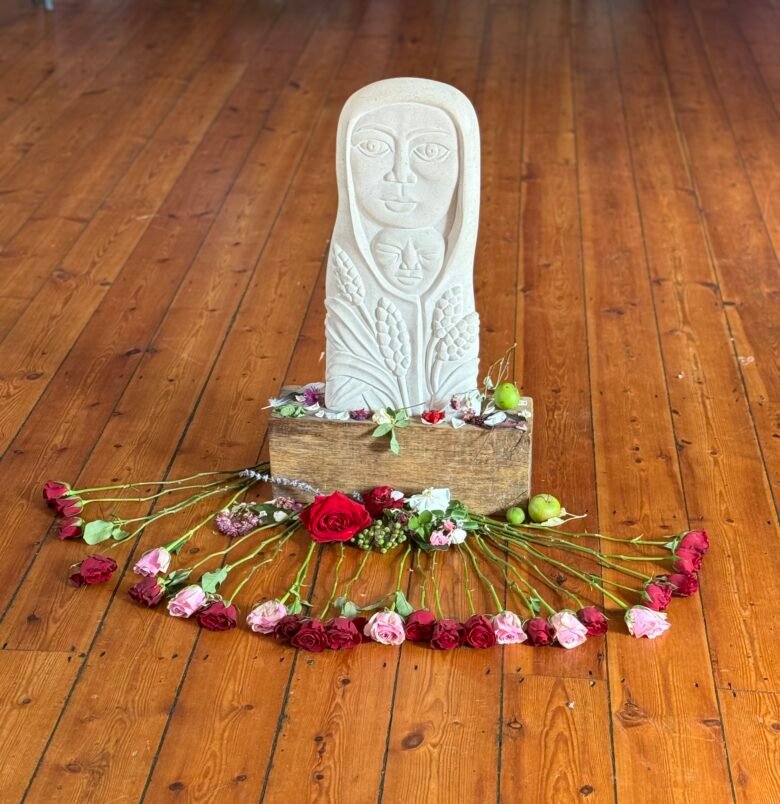
Wild Is She, None Can Make Her His Friend
Ibn Arabi
When she kills with her glances, her speech restores to life, as tho she, in giving life thereby, were Jesus.
The smooth surface of her legs is (like) the Tora in brightness, and I follow it and tread in its footsteps as tho’ I were Moses.
She is a bishopess, one of the daughters of Rome, unadorned: thou seest in her a radiant Goodness.
Wild is she, none can make her his friend; she has gotten in her solitary chamber a mausoleum for remembrance.
She has baffled everyone who is learned in our religion, every student of the Psalms of David, every Jewish doctor, and every Christian priest.
If with a gesture she demands the Gospel, thou wouldst deem us to be priests and patriarchs and deacons.
The day when they departed on the road, I prepared for war the armies of my patience, host after host.
From Poem 2 of the Tarjuman al-ashwaq
In this poem, Ibn ʿArabī presents the Beloved as far more than a human woman. She becomes a living manifestation of Divine Beauty through whom the seeker encounters God. By weaving together images from the Torah, the Gospel, Moses, Jesus, Judaism, Christianity, and Islam, he reveals that Divine Wisdom cannot be confined to a single religious form. The Beloved’s beauty “kills” the ego with her gaze and restores life through her words, just as Christ gives life. She remains “wild,” free from possession or definition, reminding us that the Divine can never be owned, controlled, or fully comprehended by doctrine or intellect. Ultimately, she is a living scripture, revealing the One Reality through many sacred expressions.
Ibn ʿArabī invites us to move beyond seeing God only in sacred texts, religious institutions, or fixed beliefs, and to begin recognizing the Divine wherever Beauty, Love, and Truth reveal themselves. The true seeker learns that every authentic revelation points toward the same Source, and that the heart—not the intellect alone—is the organ capable of recognizing it. The spiritual path, therefore, is not about possessing God or mastering religious knowledge, but about becoming inwardly empty, patient, and receptive until our own lives become transparent to Divine Presence. Like the Beloved in the poem, we are called to become living vessels through which Love itself can be seen, heard, and encountered.
This is the essence that you will find within The Aramaic Path of the Rose Training. If you feel called to exploring the Divine through beauty, love, wisdom, drumming, chanting and ancient Aramaic Prayers and Movement Meditations, the Aramaic Path of the Rose will feel like a returning home. CLICK HERE for more information.
Sending love to all of you.
AHAVA,
Ana Otero

Recently I procured a book of Ibn ‘Arabi’s wisdom. Looking forward to reading it.
The title is : THE ALCHEMY OF HUMAN HAPPINESS. Translation by Stephen Hirtenstein.
Has anyone else read this?
Beautiful! Ahava
Ana, You are pure Mastery!
Bless you. Ahava