Where has our Heart gone?
Reflection on Shared Humanity
We should all be talking about the real problem facing humanity.
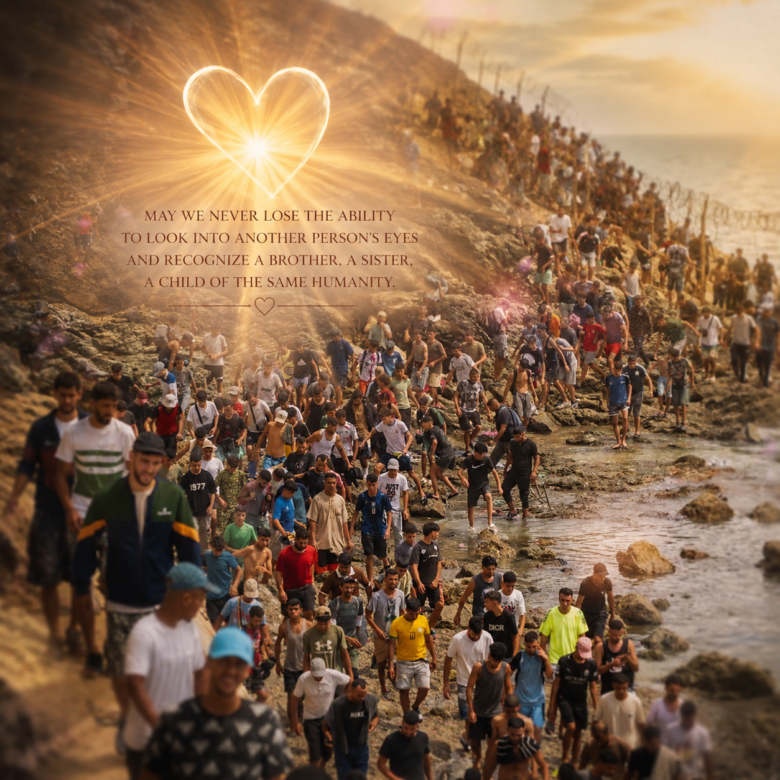
More than one hundred people have died trying to reach Ceuta. Men, women, and children throwing themselves into the sea out of desperation, often becoming pawns in political games that forget a simple truth: behind every statistic is a human face, a story, a family, and a heart that has known both love and suffering.
In truth, it was not only people who crossed the sea.
It was desperation that crossed.
It was hope that crossed.
It was grief that crossed.
It was the instinct to survive that crossed.
It was a father carrying his child on his shoulders. It was a mother holding her baby while the waves threatened to take everything from her. It was people clinging to rocks, walking, swimming, praying, fighting for the possibility of a better future—as though an entire generation had quietly resigned from the land where it was born because it could no longer offer hope.
They will be called irregular migrants.
A phrase far too polite for a tragedy that is anything but polite.
It is an expression that makes it sound as though the problem is an incomplete document or a missing stamp, when the real tragedy is that a human being came to believe that the sea was less frightening than the future waiting on land.
No one wakes up in the morning and says,
“Today seems like a beautiful day to risk drowning.”
No parent places a child upon their shoulders and walks into the sea because the weather forecast suggested the waves were favorable.
People surrender themselves to the sea only when the land beneath their feet has become another form of suffocation.
Perhaps the question we should be asking is not simply what happened at the border.
The deeper question is this:
What has happened to us?
How have we, as humanity, arrived at a place where parents believe the only hope for their children is to entrust them to the sea?
How have we created a world where a dangerous crossing becomes less terrifying than staying where one already is?
How have we become so accustomed to suffering that we debate policies before we grieve lives?
Whatever legal decisions each nation must make—and every nation has both the right and the responsibility to uphold its laws—there is something that exists before politics and before legislation.
Human dignity.
Every human being deserves food.
Every human being deserves clean water.
Every human being deserves medical care.
Every human being deserves a shower, clean clothes, and a safe place to sleep.
Whether someone ultimately remains or returns is a matter for the law.
How we treat them while they stand before us is a matter of our humanity.
Compassion should never require political permission.
We are living in a time that seems to have forgotten the sacred value of human life.
Yet this forgetting is not limited to borders.
We see it in our homes.
We see it on social media.
We see it in false accusations, in lies, in humiliation, in cruelty disguised as entertainment, and in the ease with which we stop seeing one another as human beings.
We have become remarkably efficient at reducing people to labels.
Immigrant.
Conservative.
Liberal.
Rich.
Poor.
Victim.
Enemy.
Before long, the label becomes more visible than the person.
The soul disappears behind the category.
Perhaps this is the real crisis of our age.
Not simply migration.
Not simply war.
Not simply political division.
The gradual erosion of our capacity to recognize the sacred in another human being.
When we cease to recognize the image of God in another, we slowly lose the ability to recognize it within ourselves.
Yeshua understood this.
He did not begin with categories.
He began with compassion.
He fed the hungry before asking questions.
He healed before making judgments.
He welcomed before demanding explanations.
Again and again, He showed us that love is never opposed to truth, and compassion is never opposed to justice.
Justice without compassion becomes hardness.
Compassion without wisdom becomes sentimentality.
The path of Divine Love asks us to hold both.
Those who are stronger have a responsibility to protect those who are weaker.
Not because they are superior, but because strength finds its highest purpose in service.
I also want to express my deepest gratitude to the people of Ceuta—and to everyone, Spanish and non-Spanish alike—who opened their hearts by offering food, water, blankets, clothing, medical assistance, and kindness to those who arrived exhausted and afraid.
In moments like these, they remind us that humanity has not disappeared.
The light is still here. It shines wherever one person chooses compassion over indifference.
Perhaps the greatest question is not:
“Where are they from?”
Perhaps the greatest question is:
“Who am I becoming in the way I respond to another person’s suffering?”
Because every act of compassion heals something within the one who gives it as well as the one who receives it.
May we never lose the ability to look into another person’s eyes and recognize a brother, a sister, a mother, a father, a child.
May we never forget that before we belonged to nations, we belonged to Humanity.
And before we belonged to Humanity,
we belonged to God.
This is a reflection on our shared humanity and compassion. Please refrain from political comments or any form of divisive or separatist rhetoric. Thank you for helping keep this space one of respect, kindness, and thoughtful dialogue.
AHAVA,
Ana Otero

Ahava Ana Otero beautifully said straight from the heart.
Bless you James. Ahava
At this moment, my service to Humanity, my work, it is connected to people in the situation you have talked about in this post.Your words have offered me hope,strength and a deeper reflection of my own thoughts and actions. I feel deep gratitude from my heart.🌹🤍
This is so beautiful…Ahava
This touched the core of my heart. Thank you Ana for so beautifully & powerfully expressing such sacred Truth. ♥️🌹⚜️
Bless you Tiffany. Ahava