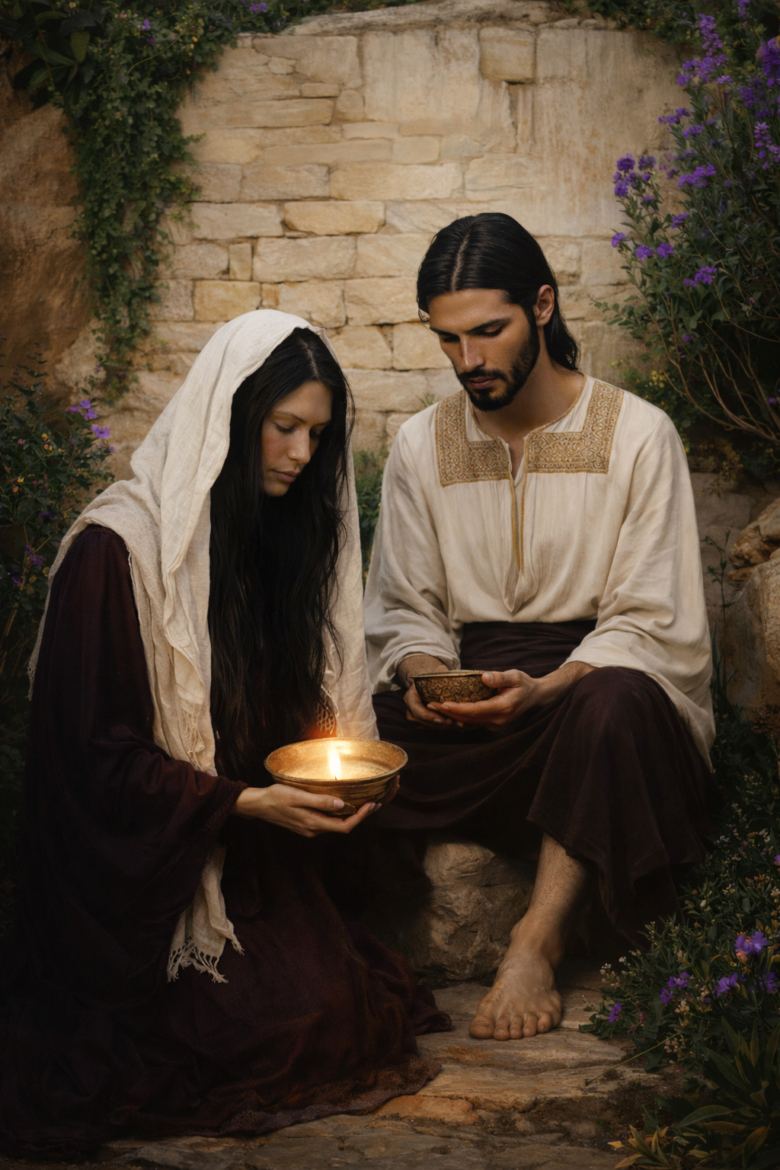
The Anointing at the Feet
The Hidden Initiation of Mary Magdalene
The anointing of Yeshua’s feet is often remembered as a tender, devotional moment — a woman weeping, perfume, humility. But in its original context, and even more in its mystical dimension, it is something far more profound.
It is prophetic.
It is socially transgressive.
It is initiatic.
And it reveals the hidden heart of the Magdalene Way.
In first-century Judea, many were waiting for a Messiah — Meshicha in Aramaic — an “anointed one” who would bring political liberation, restore sovereignty, and overturn oppression. Into this atmosphere of expectation, a woman approaches Yeshua and anoints his feet with extremely costly perfume. The Gospels tell the story with variations (Mark 14, Matthew 26, Luke 7, John 12), but the core remains the same: a woman anoints him.
John names her Mary (John 12). Mystically and devotionally, this figure has long been understood through the lens of Mary Magdalene — the woman who sees what others cannot, who stands at the cross, who witnesses resurrection, and who understands the mystery of descent before glory.
John specifies that the perfume is pure nard, rare, imported, and worth nearly a year’s wages. In the ancient world, oil and perfume carried deep meaning: hospitality, honor, healing, but also preparation for burial. And Yeshua himself interprets the act:
“Leave her alone… it was intended that she should save this perfume for the day of my burial.” (John 12:7)
“She has anointed my body beforehand for burial.” (Mark 14:8)
While others are still dreaming of crowns, Mary Magdalene understands the path of the cross. She recognizes that the anointed one is not moving toward a throne, but toward death, and through death, into a new kind of life.
How does she know?
She knows because she is inwardly aligned with the movement of the Christ Mystery. The disciples still relate to Yeshua externally — as teacher, rabbi, leader, hope. Magdalene relates to him mystically, from within the field of consciousness he embodies. She perceives the spiritual pattern already unfolding:
Descent → dissolution → transfiguration.
She understands that the Messiah is not only king, he is also passage, offering, and doorway. She reads the movement of the Spirit, not the expectations of the crowd.
The most shocking part of the scene is not only the perfume. It is where it is poured.
On his feet.
Kings are anointed on the head. Priests are anointed on the head. But the feet are the place of the path, the journey, the incarnation. The feet touch the earth; they carry destiny into matter. They are the part of the body that will walk toward betrayal, trial, and crucifixion.
In Jewish culture of the time, feet were the lowest and most impure part of the body, covered in the dust of the road. For a woman — socially restricted, religiously marginal — to approach a male teacher and touch his feet was a profound crossing of boundaries.
Yet mystically, this is cosmic consent.
In Kabbalistic language, the feet correspond to Malkhut, the indwelling Divine Presence in the world of embodiment. By anointing his feet, Magdalene seals the descent of divine consciousness all the way into the realm of suffering and matter. She is saying yes to the incarnation all the way down.
In a patriarchal religious world, men anointed men for office. Prophets anointed kings. Priests anointed priests. Here, a woman anoints the Messiah.
This revelation signals that the Christ Mystery cannot unfold without the Feminine Principle, without one who can hold descent, loss, and transformation in the body. The masculine current proclaims. The feminine current midwifes.
Magdalene’s anointing is not decorative devotion. It is priestly action. Oil seals relationship. It marks and sets apart, but it also binds the anointer and the anointed in shared destiny. In anointing him, she enters the field of what comes after.
She is not only preparing him for death. She is consenting to carry the mystery forward.
After the crucifixion, who remains at the cross?
Who goes to the tomb?
Who first encounters the Risen One?
The one who already understood that death was not the end.
Because she did not resist the descent, she becomes capable of recognizing resurrection.
This is spiritual law: only those who can stay in the night can witness the dawn.
In many esoteric Christian streams, Magdalene is seen as the one who truly understands his teaching, not only intellectually, but through embodied participation.
The anointing is her initiation as well.
This moment is a living teaching. It shows a path of consciousness:
To recognize truth before it becomes visible.
To remain present in suffering rather than turning away.
To offer love without controlling outcomes.
To serve the divine unfolding rather than personal expectation.
To walk the Magdalene path is to learn this same movement: to pour our oil — our time, attention, devotion, gifts — not where the world celebrates glory, but where life is fragile, where truth is costly, where love asks to be embodied.
The anointing at the feet reveals a spirituality of embodied compassion, prophetic insight, and courageous love — the heart of the Magdalene Way.
