Let nothing disturb you. Let nothing frighten you. God alone is enough.
On October 15th, the Feast Day of St. Teresa of Ávila was celebrated—a woman whose life and teachings continue to illuminate the mystical path of Divine Love.
Teresa of Ávila was a sixteenth-century Spanish mystic, contemplative, writer, reformer of the Carmelite Order, and Doctor of the Church. But beyond these titles, she was a woman of extraordinary spiritual courage, passionate devotion, profound intelligence, and an unwavering longing for direct communion with the Divine.
For me, St. Teresa of Ávila has always carried a powerful Magdalene frequency.
There is something in her spiritual fire, her intimacy with Christ, her devotion to the inner life, and her courage to follow the voice of the Divine that reminds me deeply of Mary Magdalene.
Both women invite us beyond an intellectual understanding of the sacred and into the living experience of Divine Love.
And both remind us that the deepest spiritual authority is born through the soul’s intimate encounter with the Beloved.
Teresa of Ávila: A Woman Who Sought Freedom
Teresa was born in Ávila, Spain, in 1515, into a family with Jewish-converso ancestry.
Her paternal grandfather, Juan Sánchez de Toledo, had been investigated and reconciled by the Spanish Inquisition in 1485 for secretly observing Jewish practices. Her family subsequently relocated from Toledo to Ávila, carrying the complicated legacy of religious persecution, conversion, and the struggle for acceptance in a society deeply concerned with ancestry and religious conformity.
I find this aspect of St. Teresa’s life particularly moving.
She was born into a world in which religious identity, social standing, and even the freedom to express one’s spiritual convictions could have profound consequences.
And she was a woman living in sixteenth-century Spain, when women’s lives were largely defined by marriage, family expectations, and the authority of men.
Teresa entered the Carmelite convent as a young woman. Her decision was deeply spiritual, but I also wonder whether, somewhere within her, there was a longing for another kind of freedom.
The freedom to devote herself to the Divine.
The freedom to cultivate an interior life.
The freedom to belong, above all, to the Beloved.
A convent in St. Teresa’s time was certainly not free from hierarchy, restriction, or control. Yet religious life could offer women opportunities for intellectual, spiritual, and communal expression that were often unavailable elsewhere.
And Teresa would eventually transform that life from within.
She founded reformed Carmelite communities centred upon prayer, simplicity, contemplation, and a more authentic dedication to the mystical path.
She became a spiritual teacher, a writer, and a guide to the mysteries of the soul.
Her writings and mystical experiences also attracted suspicion.
During the Spanish Inquisition, claims of visions, revelations, and direct encounters with the Divine could place a woman under intense scrutiny. St. Teresa’s spiritual experiences were extraordinary, and her descriptions of intimate union with Christ challenged the expectations placed upon women of her time.
Her autobiography, The Book of Life, was denounced to the Inquisition and subjected to examination.
Yet Teresa also had influential protectors, among them Gaspar de Quiroga, who became Inquisitor General of Spain.
Quiroga examined The Book of Life and judged its spiritual teachings favourably. At a time when mystical revelations could arouse suspicion, his support was of considerable importance.
Teresa and Quiroga knew one another, corresponded, and maintained a relationship marked by respect, friendship, and spiritual admiration. Teresa affectionately referred to him as Ángel Mayor—the Great Angel.
In some stories and oral retellings, it has even been suggested that Quiroga was secretly in love with Teresa. There is no established historical evidence of a romantic relationship, but what we do know is that he held her in high regard and supported her spiritual work.
I find this relationship fascinating.
Here was a woman whose writings had been questioned by religious authorities, yet one of the most powerful figures within the Inquisition recognised the depth of her mystical teachings.
And perhaps this is another dimension of Teresa’s extraordinary life: her ability to remain devoted to her inner truth while navigating a world of religious authority, political influence, and profound contradictions.
Her story reveals something remarkable—a woman who lived within one of the most restrictive religious environments in European history while remaining faithful to the truth of her own mystical experience.
Teresa’s freedom was born within her soul long before the world could recognise it.
The Inner Castle and the Magdalene Mysteries
One of St. Teresa’s most beautiful contributions to Christian mysticism is The Interior Castle, in which she describes the soul as a magnificent castle containing many dwelling places.
At its centre is the innermost chamber, where the soul enters into profound union with the Divine.
I have always loved this teaching.
Within the Magdalene–Christos mysteries, we also speak of the sacred return to the Heart, the awakening of Divine Consciousness within us, and the intimate communion between the human and the Divine.
The journey is one of remembrance.
We enter the chambers of our being, encounter the places where fear and attachment have obscured our inner light, and gradually open ourselves to a deeper relationship with Divine Love.
Teresa understood that this journey requires courage.
It asks us to become intimate with ourselves, to cultivate silence, to surrender our need for control, and to trust the mysterious movements of Grace.
And here I feel the Magdalene so profoundly.
Mary Magdalene, standing in the garden of the Resurrection, hears the voice of the Risen Christ calling her by name.
Teresa, entering the innermost chambers of the soul, encounters the Divine Beloved in the sanctuary of her own being.
These are distinct spiritual stories, yet within my mystical understanding, they illuminate the same sacred movement:
The soul awakens through Love, recognises the Divine Presence, and becomes a living expression of that Presence upon the Earth.
For St. Teresa, mystical union was never simply an extraordinary experience to be admired. Her spiritual life was also expressed through perseverance, friendship, service, courage, and the practical work of establishing communities.
And this, too, is deeply Magdalene for me.
Divine Love is meant to be embodied.
Beneath the Andalusian Moon: A Procession for St. Teresa
I live in a beautiful seaside village in Andalusia, in the south of Spain, a land so deeply rooted in Marian devotion, sacred processions, pilgrimages, and centuries of mystical tradition.
It is a blessing to live among these expressions of faith and to experience how the sacred continues to weave itself into everyday life.
Here, devotion is something you can encounter while walking through the streets, listening to church bells, entering a small chapel, or witnessing a procession in which generations gather to honour the Divine Mother and the saints. There is something deeply moving about this continuity of sacred tradition.
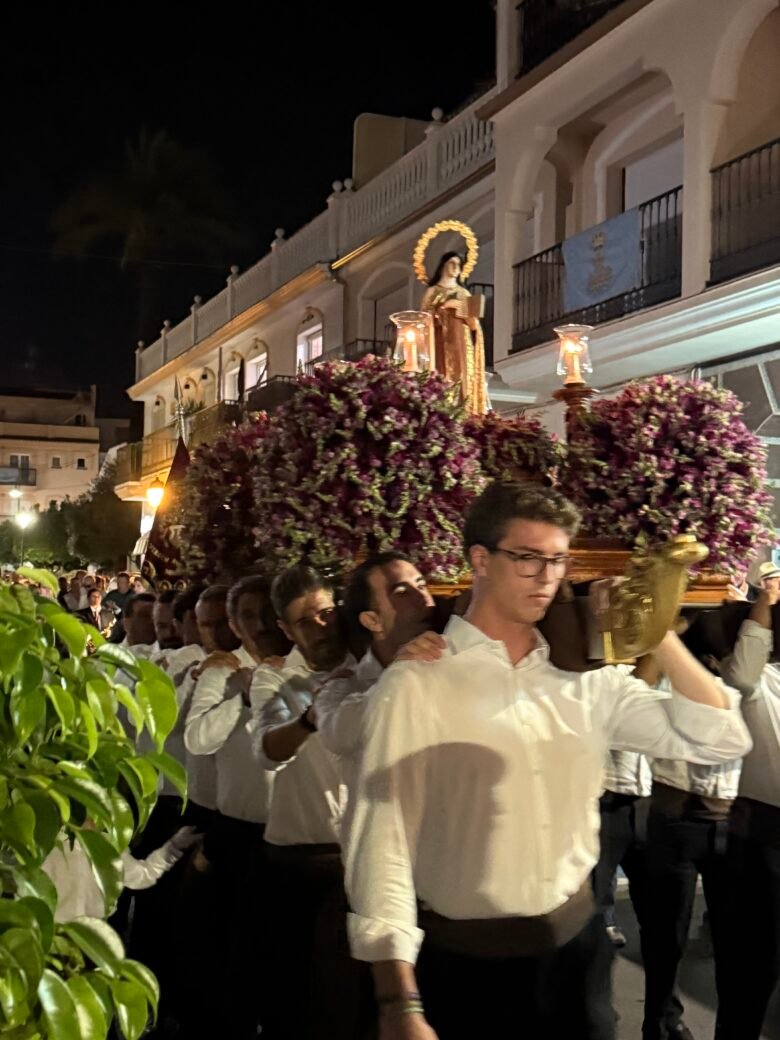
On the evening of Teresa’s feast day, our village honoured her with a beautiful procession through its streets. Men carried her sacred statue upon their shoulders, moving slowly through the village as the community gathered in devotion. She was adorned with purple flowers, the colour associated with her, and before the men picked her up to be carried, people were offering her flowers and rose petals.
There was something profoundly moving about witnessing this centuries-old tradition beneath the Andalusian sky: the beauty of the streets, the rhythm of the procession, and the image of this extraordinary woman being carried with such reverence.
And I found myself reflecting on the contrast.
A woman who, during her lifetime, had to navigate suspicion, religious authority, and the limitations placed upon women was now being carried through the streets with honour and devotion.
A woman whose mystical experiences were once questioned had become one of the most beloved spiritual figures in Spanish history.
And as we continued walking through the beautiful village streets beneath the moonlight, the words of St. Teresa’s beloved prayer kept repeating within my heart:
Let nothing disturb you.
Let nothing frighten you.
All things are passing.
God never changes.
Patience obtains all things.
Whoever has God lacks nothing.
God alone is enough.
Nada te turbe. Nada te espante. Solo Dios basta.
These words carry such profound wisdom, especially during those passages of life when everything around us seems to be changing.
There are seasons when the familiar forms of our lives begin to dissolve. Relationships change. Dreams take unexpected directions. We are invited to release what we have known and enter passages whose destinations are not yet visible.
And in these moments, Teresa’s prayer becomes a beautiful invitation to return to the eternal Presence within.
She understood that the spiritual path is a journey into the innermost chambers of the soul, where we discover a Presence that remains constant through every season of our lives.
This is not an invitation to withdraw from life or deny our human emotions. It is an invitation to become so deeply rooted in Divine Love that we can meet life’s changing circumstances with greater clarity, compassion, and trust.
Teresa’s words remind us that peace is cultivated through our relationship with the Divine, through prayer, through surrender, and through the gradual awakening of the heart.
The Magdalene Frequency of Teresa of Ávila
When I speak of Teresa carrying a Magdalene frequency, I am speaking of a spiritual resonance that I recognise in her life and teachings.
The Magdalene frequency is the consciousness of Divine Love awakened within the human heart and embodied through our lives. It is the courage to enter into direct relationship with the Divine. It is the sacred fire of devotion. It is the wisdom of the heart. It is the willingness to surrender everything that separates us from Love. And it is the understanding that our relationship with the Divine is intimate, living, and transformative.
St. Teresa carried this fire. Her spirituality was deeply personal, passionate, and rooted in an extraordinary intimacy with Christ.
Like Mary Magdalene, she reminds me of the soul’s longing for the Beloved and the transformation that unfolds when that longing becomes the centre of our lives.
She also reminds me that the mystical path is not always gentle. It asks for courage, discernment, patience, and a willingness to remain faithful to the inner call, even when the world does not understand.
And perhaps this is why her words have such power centuries after her death. They emerge from a woman who knew the complexity of human life, the challenges of spiritual devotion, and the extraordinary grace of discovering the Divine within.
Solo Dios Basta – God Alone is Enough
That evening, walking beneath the Andalusian moon, I felt the simplicity and extraordinary depth of Teresa’s message once again.
Solo Dios basta.
God alone is enough.
Within these words, I hear the invitation to return to the source of our being, to the Love that sustains us beneath the changing circumstances of our lives.
The world continues to move. Seasons change. We grow, we grieve, we create, we surrender, and we begin again.
And through it all, the Divine Presence remains available within the sanctuary of the heart.
Perhaps this is the great wisdom St. Teresa of Ávila offers us today.
That spiritual freedom is an interior awakening.
That devotion is a living relationship.
That the soul is a sacred dwelling place.
And that the Love we seek has been waiting to welcome us into its innermost chamber.
Everything changes. Everything passes. Yet the Love that sustains us remains.
May the wisdom of St. Teresa of Ávila inspire us to enter the inner castle of our souls, to cultivate the sacred fire of devotion, and to allow Divine Love to become visible through the way we live.
AHAVA,
Ana Otero

Ahava y Bendiciones Ana, que la memoria extática y ancestral de Santa Teresa de Ávila nos rodee y guíe en los pasajes del alma
ܪܘܚܐ ܕܚ̈ܝܐ
Rūḥā d-Ḥayyē
Bendiciones Lena! Ahava
Thank you Ana for sharing such a deeply inspirational message about St. Teresa of Avila. I have appreciated receiving your emails and feel a resonance with your continued emphasis on the importance of the soul’s union with the Divine Love of the Beloved. While you’re in Spain and I’m in Eugene, OR in the United States there really is no distance between souls attuned to the Magdalene frequency of Divine Love. My dearest friend, Fatima who lives in my town is from Spain and we share a brother/sister relationship rooted in this love. Sending you blessings of love and appreciation for the dedication and devotion to the work you share 🙏💕☺️
Dear Jonathan, thank you for such a powerful message and we are all united, as if in a dimension that is earthly, heavenly and beyond boundaries. Like you have said, there is no distance between souls attuned to the Magdalene Frequency of Divine Love. Thank you for your words and your presence. AHAVA