Maryam Magdalitha
From Migdal Nunaya to the Rosette Stone
Mary Magdalene, Maryam Magdalitha, is introduced in the Gospels not by a family lineage name but by the place she came from: “Mary who is called the Magdalene” (Luke 8:2; Mark 16:1). That epithet connects her with a real town on the western shore of the Sea of Galilee, known in ancient Jewish sources as Migdal, meaning “tower” (Hebrew: Migdál).
More specifically, rabbinic texts refer to the place as Migdal Nunayya, the Tower of Fish, likely pointing to the region’s flourishing fishing industry. This name appears in the Babylonian and Jerusalem Talmuds, indicating how locals understood their town long before Christian tradition attached it to Mary.
In Greek and Roman sources the town is sometimes associated with the name Taricheae, referring to fish salting and curing, a common coastal industry of the time. Whatever the specific ancient name people used, the town’s Jewish identity was strong: it was a thriving settlement, an urban center with a harbor and marketplaces, woven into the daily life of Galilee in the early first century — the world where Jesus, Mary Magdalene, and many of the earliest Christian figures lived and moved.
Archaeological evidence shows that Magdala was a prosperous Jewish town in the late Second Temple period, with homes indicating considerable wealth and attention to Jewish ritual purity (as shown by private mikva’ot, ritual baths).
It sits just north of Tiberias and would have been part of the everyday geography of Galilean life: the lakeshore towns where Jesus traveled, taught, and taught in synagogues. Though the Gospels do not explicitly say Jesus taught in the Magdala synagogue, they do record that he went throughout Galilee teaching in all synagogues (Matthew 4:23), and Magdala falls squarely within that orbit.
In this cultural context, Mary of Magdala was a Jewish woman fully steeped in the rhythms of synagogue life, connected to scripture, community gatherings, study, and ritual devotion.
One of the most exciting archaeological discoveries in recent decades was the excavation (2009) of the Migdal Synagogue, a first-century Jewish house of worship dating to the period of Jesus’ ministry.
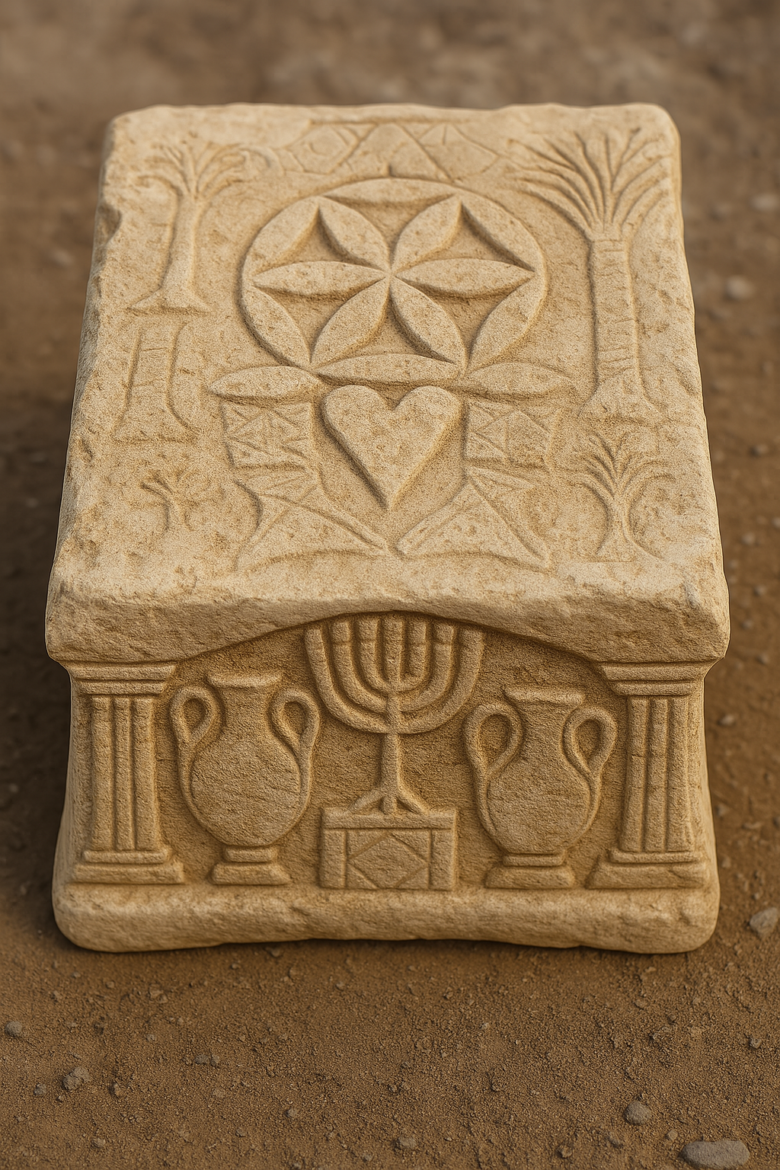
This synagogue was not a simple meeting room. It was an architectural space richly built with basalt and limestone, decorated frescoed walls, stone benches lining the hall, and, most remarkably, a carved stone now known as the Magdala Stone.
The Magdala Stone was found in situ in the center of the synagogue hall — a limestone block with decorative carvings on all sides, including a seven-branched menorah, the earliest known such depiction outside Jerusalem in a synagogue context.
Scholars believe the stone may have served as a base for a Torah reading table, underscoring the centrality of Scripture and communal prayer in the synagogue.
More intriguingly, the six-petaled rosette carved on its surface carries deep symbolic resonance. Many archaeologists see parallels between the rosette and floral imagery associated with the sacred veil of the Jerusalem Temple. The sacred veil of Jerusalem Temple symbolized the most sacred space where the Divine Presence dwelled.
The rosette served as visual theology for the community, a reminder that the presence of God was as near in Galilean synagogues as in the Temple itself. In this light, the rosette embodies a spiritual statement — that the community gathered there participated in a living tradition of divine presence, not abstract doctrine, but embodied encounter.
The six-petalled rosette appears across ancient sacred traditions — in Near Eastern temples, in Egyptian sanctuaries, in Jewish ossuaries, in early Christian art, and in later Islamic geometry.
Mystically, the six petals form the geometry of interwoven triangles — heaven and earth, spirit and body, masculine and feminine — meeting at a center that cannot be drawn, only entered. It is the same geometry that later becomes the Seal of Solomon, the Star of David, the Merkaba. But in its floral form, it is softer, more embodied, more womb-like. Not a symbol of power, but of presence.
The rosette is the point where opposites dissolve. It is a map of union.
Six petals move around a hidden center, a silent womb of stillness. This center is the Holy of Holies within the heart. The place where God does not speak in words, but in being.
In Temple symbolism, floral motifs adorned the veil of the Holy of Holies (The Jerusalem Temple). The rosette echoes that veil — reminding the worshipper that the sanctuary is not only behind a curtain in Jerusalem, but within the human body itself. This is very important, as it is already connected to the moment of Yeshua´s death on the cross. The moment Yeshua takes his last breath, the veil of the Temple breaks, creating a new covenant, one where there is a direct relationship with God, one where we no longer need high priests or dogmatic restrictions to experience Divine Presence.
On the Magdala Stone, the rosette stands beneath the menorah, beneath Light. As if to say:
Light descends into the womb of form.
Spirit enters matter.
The Infinite chooses to be held.
Esoterically, the six petals represent:
- The six directions of sacred space — east, west, north, south, above, below
• The six days of creation
• The six movements of incarnation
• The six gates through which the soul enters embodiment
And at the center: the Seventh — Shabbat — rest, presence, Shekhinah.
The rosette is therefore not a decoration.
It is Shabbat in stone.
It is the symbol of the Divine resting within form.
It is the geometry of Shekhinah, the Divine Feminine Presence, dwelling.
It is the womb of Christ Consciousness.
That this rosette appears in Magdala, the home of Mary Magdalene, teaches us so much about the well of spirituality she drank from.
The Magdalene herself embodies what the rosette reveals:
She is the place where heaven and earth meet.
She is the flower of incarnation.
She is the center where revelation rests in form.
The rosette does not open outward.
It opens inward.
It teaches that the Kingdom is not ascended into, it is entered through presence.
The six petals are the journey.
The center is remembrance.
And the Magdalene stands as guardian of that center.
The six-petalled rosette is the geometry of divine intimacy, it is the Bridal Chamber.
It teaches us:
You are not outside the sanctuary.
You are the sanctuary.
You are not approaching the Holy.
You are where the Holy chose to dwell.
You are allowed to hold God.
You are allowed to be the meeting place.
You are allowed to be the flower through which Light remembers itself.
Understanding Magdala, Migdal Nunaya, in its ancient context transforms how we perceive Mary Magdalene as human, as woman. This was not a peripheral village of simple devotion, but a living center of embodied Judaism, where scripture, symbol, and daily life were woven together through presence.
The Magdala Stone itself testifies to this. Its rosette, its menorah, its sacred carvings reveal a community whose spirituality was not abstract, it was lived, practiced and remembered through devotion.
The six-petalled rosette reveals a Judaism that honored the Divine Feminine Presence, the Shekhinah, as a dwelling reality. A Judaism where God was not only transcendent, but indwelling. Where holiness was not only above, but within.
This symbol invites a feminine way of relating with God:
Through community.
Through intimacy.
Through practice.
Through embodiment.
Within this context, Mary Magdalene emerges as a natural daughter of an embodied spirituality.
She was rooted in Jewish life and scripture.
She was shaped by synagogue rhythms, prayers, and symbols.
She belonged to a culture where sacred imagination was alive in daily life.
Mary Magdalene was born into a world where Torah was not merely recited, it was felt in the bones and breath of daily life. Where devotion was relational. Where wisdom was lived. Where God was not only spoken about, but encountered.
She did not need to become mystical.
She was raised within mysticism.
The rosette therefore becomes more than a symbol of geometry. It becomes a revelation of Magdalene Consciousness itself.
It teaches that the Divine is held, that holiness is a state of reception and
that wisdom completely opens us up to our true essence.
The rosette teaches a feminine spirituality that does not compete with the masculine, but completes it.
In this light, Mary Magdalene is the embodied continuation of a lineage that already knew how to hold God within form.
Upcoming Events:
Magdalene Shabbat, January 30th. The Kingdom within the Womb. CLICK HERE
Magdalene Ministry Priestess and Priest Training temple doors are open until February 2. Once they close, the Temple Doors will not open again until January 2027. CLICK HERE
Aramaic Healing Concert in Glastonbury. To join us live at St. Margaret´s Chapel, CLICK HERE. To join the live-streaming, CLICK HERE.
Desert Rose Membership. Next workshop: Month of Shevat, Aquarius. Sarah Tamar and the Dragon Rose. CLICK HERE
I am wishing all of you a radiant Shabbat Day.I thank all of you for being in this Community. May the Magdalene Rosette live within us.
AHAVA,
Ana Otero
