Mary Magdalene
The Fire That Rises from the Earth
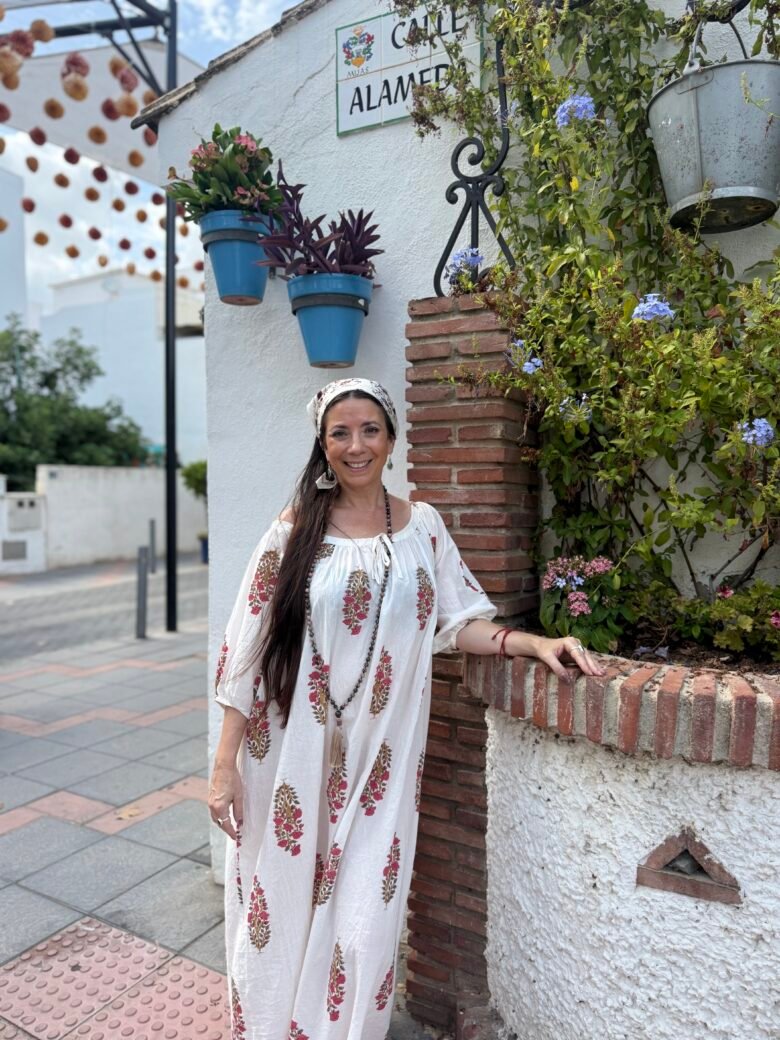
The other day, as I was walking through the raw and luminous Andalusian landscape of the mountains of Mijas, where I live, something moved through me with such force that I had to stop. It rose through my body almost as if the earth beneath my feet had suddenly become alive. I knew this sensation. I have felt it many times throughout my life, particularly in moments of prayer, dance, grief, creativity, and profound spiritual opening. For me, it carries the unmistakable presence of the Magdalene.
And in that moment, one of my favourite poets entered my awareness: Federico García Lorca.
Lorca was Andalusian. He understood that there are experiences that cannot be separated from the land that gives birth to them. His poetry is filled with moon, blood, horses, rivers, knives, olive groves, lamentation, desire, death, and impossible longing. Flamenco and cante jondo, the “deep song” of Andalucía, profoundly shaped his imagination; scholars have long recognised the importance of Andalusian folklore, flamenco, and cante jondo throughout his work.
In his famous 1933 lecture Juego y teoría del duende—Play and Theory of the Duende—Lorca describes three different spiritual forces that participate in the birth of great art, mission, creations, healing and vision: the angel, the muse, and the duende. His distinction is extraordinary. The angel brings illumination; the muse gives form and intelligence. Both, Lorca says, come to us from outside. The duende is different. It must be awakened from within, from what he calls the deepest chambers of the blood.
This is where Lorca becomes, for me, a mystic of embodiment.
Angel, Muse and Duende
The angel brings grace. There is light around the angel. There is beauty, elegance, protection, and the mysterious sense that something greater than ourselves has entered the room. We know this experience when we walk into an ancient church and light falls through stained glass, when a piece of music suddenly opens the heart, or when something arrives with such ease and beauty that we can only call it Grace.
The muse has another quality. Lorca associates the muse with form, intelligence, structure, and cultivated inspiration. In my own contemplative understanding, I experience the muse as the one who receives. She listens. She channels. She brings the inspired word into form. She is connected with poetry, prophecy, language, metaphor, intellect, and revelation. The muse can place a mirror before us and allow us to recognise beauty where before we saw only fragmentation. We feel Ruḥa d’Qudsha, the Holy Spirit, in this movement of inspiration: Breath becoming Word, the invisible entering language.
And then there is duende.
If you look up the Spanish word duende, you may find translations such as goblin, sprite, or elf. None of these convey what Lorca means. Duende is something almost impossible to translate because it names an experience rather than an object: a magnetic, telluric force that enters us and transforms both the one creating and the one witnessing it.It is earthy, and has the power to draw something more truthful than what we ever have experienced or offered to the world.
The angel descends.
The muse arrives.
But the duende rises.
It rises from the earth. It rises through the blood. It rises from the places within us that have known love deeply enough to know loss. It cannot simply be summoned through technique, education, spiritual knowledge, or aesthetic perfection. Duende requires struggle; unlike the angel or muse, it is something we must wrestle with.
This is why duende sends shivers through the body.
We do not merely understand it.
We recognise it in our bones.
Duende is what enters when the vessel breaks open.
Lorca was fascinated by cante jondo (flamenco singing) precisely because of this concentrated intensity. He described the deep song as something stripped of unnecessary ornament, turned inward upon itself, capable of giving almost material form to an interior feeling.
He also observed that a flamenco dancer stamps her foot into the earth and the sound does not simply mark rhythm. It becomes declaration. The spine rises, the arms open, the face ceases to perform. Something ancestral moves through her.
The earth answers.
This is why the feet are so important in flamenco. The dancer does not dance above the earth. She He enters relationship with it. Heel, sole, toe, weight, pelvis, breath—the body continually strikes and receives the ground. The dance becomes a dialogue between gravity and transcendence.
And this, for me, is profoundly mystical.
We often imagine spirituality as ascent: rising above the body, becoming lighter, moving upward toward Heaven. Flamenco reveals another direction of revelation. Sometimes God comes up through the earth.
Sometimes revelation begins beneath the soles of our feet.
Lorca understood that duende carries an intimacy with death. He writes repeatedly of its attraction to the wound, the edge, and places where familiar forms begin to dissolve. This does not mean that suffering automatically creates great experiences, nor that pain should be romanticised. It means that when we have truly encountered the fragility of being alive, something superficial can fall away.
We know that we will lose what we love.
We know that beauty passes.
We know that every sunset disappears even as we are watching it.
We know that the body changes, that relationships transform, that those we love will one day leave, and that we ourselves are passing through this world for only a moment.
Duende begins when we stop pretending otherwise.
And then—strangely—life becomes more beautiful.
Because the rose matters precisely because it will wither.
The embrace matters because it will end.
The song matters because the final note is already contained within the first.
Duende is the bittersweet intelligence of impermanence entering the body and becoming form.
The angel guides. The muse gives form. The duende wounds the form itself.
It interrupts.
It destabilises.
It takes what has become beautiful, controlled, sophisticated, or safe and brings it back to the abyss from which authentic creation is born.
Duende cannot be replicated.
The same singer can sing the same song tomorrow and something entirely different will happen. The same dancer can perform the same choreography, yet the moment of duende can never be reproduced because it belongs absolutely to the present.
This is why duende resembles mystical experience.
We cannot manufacture God.
We cannot manufacture revelation.
We can prepare the sanctuary. We can pray. We can practise. We can purify the instrument. We can show up.
And then something comes alive that belongs neither completely to us nor completely outside us.
Creation begins moving through us.
Mary Magdalene and the Duende
This is precisely where I encounter Mary Magdalene.
There are many ways to approach her. We can experience Magdalene as muse: teacher, wisdom bearer, apostle, receiver of revelation, guardian of the Living Word.
We can experience Magdalene as angelic presence: beauty, devotion, fragrance, light, tenderness, the luminous intimacy of the Beloved.
But there is another Magdalene.
The Magdalene of the earth.
The Magdalene of blood.
The Magdalene of the tomb.
The woman who remains close enough to death to become the first witness of Resurrection.
This is the Magdalene of duende.
She stands at the threshold where love and mortality meet. She knows the unbearable vulnerability of loving something that can be lost. She knows what it means to remain when the form through which Love has been known is taken away. She knows the Cross, the tomb, the silence before dawn, and the moment when grief suddenly becomes revelation.
Mary Magdalene does not bypass death in order to reach Resurrection.
She passes through it.
And this is why, for me, she carries duende.
Her spirituality is embodied. She weeps. She touches. She anoints. She runs. She remains near a tomb. Her revelation is not an intellectual conclusion but an event that moves through the entire body.
When Yeshua calls her by name in the garden, something cracks open.
“Maryam.”
One word.
Grief becomes recognition.
Absence becomes Presence.
Death opens into Life.
This movement is deeply Andalusian to me because it contains the same mystery held within the deepest flamenco: life, death, death, life.
Resurrection does not erase sorrow.
It transforms our relationship with it.
The Magdalene Fire Rising Through the Earth
The first time I experienced a visitation of Mary Magdalene, I experienced her through my body.
There was a fire that seemed to rise from beneath me, entering through my feet and moving upward through the earth of my own body. It entered my womb, penetrated my heart, and expanded outward until I felt that something within me had broken open.
Years later, when I returned again and again to Lorca’s understanding of duende, I recognised the experience.
This was not an angel descending from above.
It was something rising.
Something earthy.
Something fierce and tender at once.
Something that asked for the whole of me.
And perhaps this is why my own relationship with Mary Magdalene has always remained inseparable from the body, from sacred dance and drumming, from the desert, from grief, from desire, from the Earth, and from the mysteries of death and resurrection.
For me, the Magdalene is not only the woman dressed in red standing serenely in a Renaissance painting.
She is also the woman with dust on her feet.
The woman whose hair carries fragrance.
The woman whose eyes have swollen from weeping.
The woman who walks through darkness before dawn because Love gives her no other choice.
She has duende.
The Black Earth of the Feminine
There is another current here that brings me toward the mystery of the Black Madonna.
The Black Madonna draws the feminine away from an exclusively celestial ideal and returns her to earth, womb, darkness, fertility, grief, mystery, and incarnation. She carries the memory that the sacred feminine is not only luminous.
She is also fertile darkness.
She is soil.
She is womb.
She is the black earth into which the seed disappears before resurrection.
This is the same earth from which duende rises.
Perhaps this is one reason Mary Magdalene continually calls us toward the parts of spirituality we might prefer to avoid: the places where we are vulnerable, unfinished, grieving, longing, desiring, aging, losing, changing.
She does not tell us to become less human so that we can become more Divine.
She asks us to enter our humanity so completely that the Divine can be found within it.
This is embodied mysticism.
To Have Duende Is to Become Real
Lorca’s angel and muse remain beautiful and necessary. We need inspiration. We need intelligence. We need structure, revelation, beauty, grace, and light.
But duende asks for something else.
It asks for truth.
And truth is rarely polished.
There comes a moment in every authentic spiritual journey when the spiritual identity itself must break. We can no longer survive through beautiful language, perfect rituals, sophisticated teachings, or ideas about awakening.
The soul wants what is real.
This is where duende waits.
At the edge.
Inside the unanswered prayer.
Within the heartbreak.
Beneath the feet.
Inside the blood.
It waits until we are willing to stop performing spirituality and become vulnerable enough to be transformed by it.
And perhaps this is why I feel Mary Magdalene so strongly in Lorca’s duende.
She carries angel.
She carries muse.
But she also carries the force that takes us into the tomb and returns us to the garden transformed.
The more deeply we allow duende to move through us, the more truthful our creativity becomes. The more truthful our creativity becomes, the more transparent we become to inspiration. And perhaps then the muse and the angel can finally enter without obstruction.
Duende breaks open the vessel. The muse gives what has been revealed a form. The angel gives it light. And together, something sacred becomes visible.
As I walked through the mountains of Mijas that day, I understood again why Andalucía has always spoken so profoundly to my soul. Beneath the white villages, beneath the brilliant sun, beneath the bougainvillea and the Mediterranean blue, there is another Andalucía.
Ancient.
Raw.
Earthbound.
An Andalucía that knows lamentation.
An Andalucía that understands that the deepest beauty carries within it the knowledge that everything passes.
Perhaps this is also why I continue to feel Mary Magdalene here.
Because somewhere between the earth and the wound, between the heel striking the ground and the voice breaking open, between the tomb and the garden, something rises.
Whether call it duende or Magdalene Fire, when it rises through us…
We become the place where life, death, love, and resurrection meet—and from that sacred meeting, something that has never existed before is born.
Soon I will be sharing all of the information on The Marian and Magdalene Pilgrimage in Andalusia, the South of Spain.
Join me on August 28th for our monthly online Magdalene – Christos Shabbat. CLICK HERE
Registration is open for The Aramaic Path of the Rose Accredited Training. CLICK HERE
Community Gathering: Celebrating the Mystical Birth of Mother Mary. September 8th. CLICK HERE
Ahava,
Ana Otero

Gracias por poner en palabras y compatir lo inasible, Ana. Gracias.
Ahava!
Preciosos artículo.
Real como la vida vida misma.
hoy he entendido mucho mejor que es la Madalena como se dice en Andalucia o La Malena.
De verdad me ha encantado, me ha llegado muy, muy adentro. Me ha llenado por dentro
Gracias. Gracias. Gracias.
Nos amo. Ahava