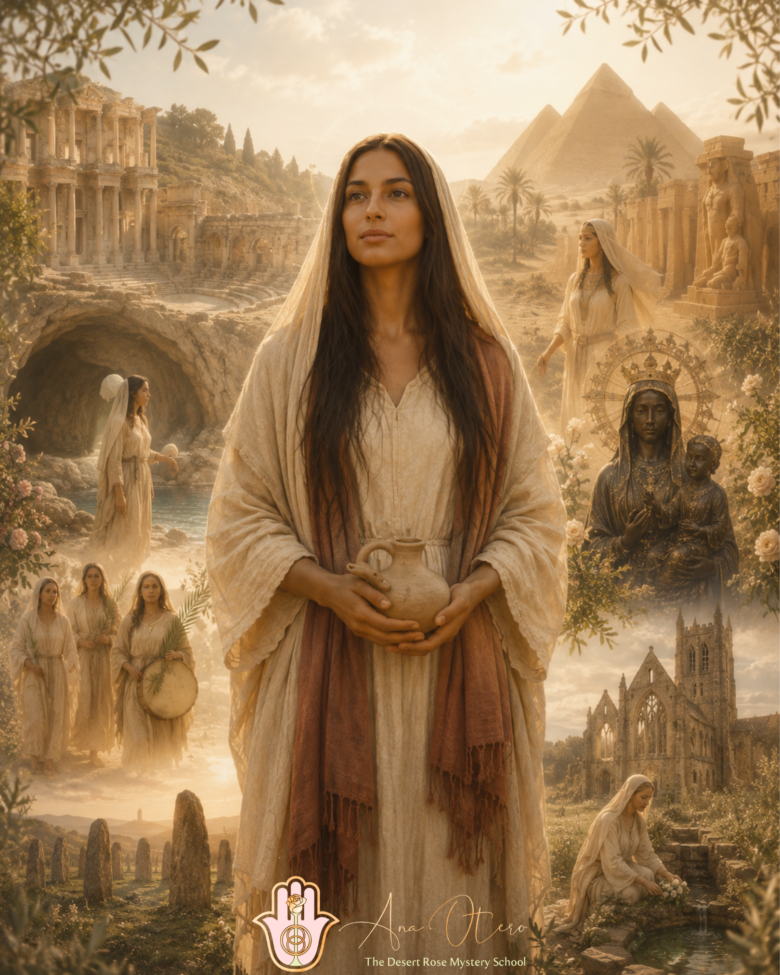
Mary Magdalene After the Crucifixion
The Lands That Carry Her Memory
For centuries, pilgrims, mystics, historians, and devotees have carried stories of where Mary Magdalene walked after the crucifixion of Yeshua. Her presence echoes through deserts, caves, coastal sanctuaries, ancient churches, and hidden mountains. Entire regions of the world hold her memory within their stones.
Some traditions emerged through oral devotion and mystical transmission. Others rest upon older historical foundations preserved through early Church writings and pilgrimage accounts.
Among all the places associated with her final years, one location rises with the strongest historical continuity: Ephesus.
Ephesus — The Strongest Historical Tradition
The tradition placing Mary Magdalene in Ephesus (Modern Day Turkey) remains the oldest and most historically cohesive narrative surrounding her final years.
This tradition lives within the Eastern Orthodox Church and flows naturally alongside the documented movements of the Apostle John and the early Christian community.
According to the Gospel of John, Yeshua entrusted his mother, Mary, into the care of John while upon the cross. As persecution intensified in Jerusalem, John eventually traveled to Ephesus, one of the great spiritual and intellectual centers of Asia Minor. Eastern Christian tradition carries the understanding that both Mother Mary and Mary Magdalene journeyed with him into this region.
Ephesus became a sanctuary for the early followers of the Way of Christ Yeshua.
Within this tradition, Mary Magdalene continued teaching, transmitting wisdom, and serving alongside the beloved disciple. Ancient accounts describe her living her final years there, immersed in the sacred work of the emerging mystical Christian communities.
One of the most compelling aspects of the Ephesian tradition lies in the continuity of its relic history.
Byzantine records state that the relics of Mary Magdalene were transferred from Ephesus to Constantinople in the 9th century under Emperor Leo VI. This creates a documented historical trail that stretches far earlier than many of the later medieval European legends.
Pilgrims traveling through the region during the early centuries also recorded being shown a tomb associated with Mary Magdalene near Ephesus. These accounts appeared centuries before the French narratives emerged.
The region itself still carries this energy.
Near the ancient ruins stands House of the Virgin Mary, a pilgrimage site nestled within the hills above Ephesus. The presence of this sanctuary reinforces the ancient belief that members of Yeshua’s inner circle spent their final years within this sacred pocket of Asia Minor.
There is something deeply coherent about the Ephesus tradition. It rests within the geography of the early Church, the movements of John, the Byzantine record of relics, and the continuity preserved by Eastern Christianity.
Historically and factually, Ephesus remains the place most strongly connected to where Mary Magdalene likely went after the crucifixion.
Egypt — The Desert of Wisdom and Initiation
Another ancient current places Mary Magdalene within Egypt.
This tradition emerges less through formal historical documentation and more through the mystical and spiritual atmosphere of early Christianity itself.
Egypt became one of the great cradles of mystical Christianity. Alexandria stood as a center of sacred learning, philosophy, Gnosticism, Jewish mysticism, and esoteric spiritual schools. The Egyptian desert later became home to the Desert Mothers and Desert Fathers, initiates who withdrew into silence, contemplation, and prayer.
The Gospel of Mary, the Gospel of Philip, and several Gnostic texts connected to Magdalene spirituality survived through Egyptian discoveries, especially through the Nag Hammadi library uncovered in Upper Egypt in 1945.
For many mystics, Egypt carries the energetic memory of hidden wisdom traditions linked to Mary Magdalene and the inner teachings of the early Christ movement.
Some traditions suggest she traveled there as part of the dispersion of early followers after persecution intensified in Jerusalem. Egypt already housed large Jewish communities and offered relative safety and intellectual openness.
While the historical evidence remains lighter than the Ephesian tradition, Egypt continues to hold a profound spiritual and mystical connection to the Magdalene current, and, as Her Gospel was found here, this indicates that she had a strong following of disciples, students, that honored her as Teacher of the Christ Mysteries.
Southern France — The Land of Pilgrimage and Devotion
The French tradition surrounding Mary Magdalene became one of the most beloved devotional narratives in Western Christianity.
According to Provençal tradition, Mary Magdalene arrived on the southern coast of France with Lazarus, Martha, and companions after fleeing persecution in the Holy Land. Their boat supposedly landed near Saintes-Maries-de-la-Mer.
From there, Magdalene eventually withdrew into the mountains of La Sainte-Baume, where tradition says she lived for many years in prayer, contemplation, and communion with the Divine.
The cave of Sainte-Baume became one of the great pilgrimage sites devoted to her memory.
There is immense spiritual beauty within this tradition.
Pilgrims for centuries entered those forests and mountains carrying devotion to the Magdalene. Prayer itself leaves an imprint upon the land. Sacred geography forms through remembrance, ritual, and love.
Historically, the written accounts surrounding the French narrative appeared much later, primarily during the medieval period around the 13th century. The historical continuity does not reach as far back as the Ephesian tradition.
There is no early historical evidence or biblical record placing Mary Magdalene in France after the crucifixion, and from a historical perspective, Ephesus remains the most coherent and strongly supported destination connected to her later life.
Yet sacred geography also forms through devotion.
When generations of pilgrims enter a land carrying prayer, reverence, remembrance, and longing for the Divine Feminine, the landscape itself begins to hold that frequency. Through centuries of pilgrimage, contemplation, chants, rituals, and love directed toward Mary Magdalene, southern France became one of the great devotional centers of the Magdalene current.
So while France was likely not the place where she physically spent her final years, the land genuinely carries her presence for many souls because devotion itself creates a vibrational field. Prayer leaves an imprint upon the earth. Collective remembrance opens spiritual pathways through which sacred consciousness becomes felt and experienced.
In this way, Provence became less a historical destination and more a living sanctuary of Magdalene devotion.
The land always remembers what people pray into it.
Catalonia and the Mountains of Hidden Transmission
Another fascinating thread appears within Catalonia (Spain), especially through the mystical atmosphere surrounding monasteries, sacred mountains, Black Madonna traditions, and hidden currents of early Christianity.
One place often associated with these esoteric traditions is Monastery of Santes Creus.
While no direct historical evidence places Mary Magdalene physically there, Catalonia carries a powerful Magdalene resonance through its sacred geography and medieval mystical currents.
The region became deeply connected to Grail traditions, Black Madonna devotion, contemplative Christianity, and hidden streams of esoteric wisdom. The mountainous landscapes of Catalonia echo the same archetype found in Provence: caves, silence, retreat, pilgrimage, and revelation.
Nearby, Montserrat radiates the mystery of the Black Madonna — the dark womb of divine wisdom, hidden light, and sacred feminine presence.
Many mystics perceive a living energetic thread connecting Magdalene traditions across southern France, Catalonia, Jerusalem, and the Mediterranean coastline.
Certain sacred geographies are believed to hold powerful earth currents often referred to as dragon lines or ley lines, energetic pathways through which spiritual force moves across the land. Catalonia, Montserrat, the Mediterranean coast, and parts of the Balearic Islands have long been associated within mystical traditions with these currents of heightened spiritual energy.
For many mystics, the mountains of Catalonia hold a profound energetic relationship with Jerusalem and the Holy Land, as though certain frequencies of the early Christ current became seeded within these lands through pilgrimage, devotion, oral transmission, and mystical practice.
Trade routes, pilgrimage paths, monastic communities, and oral traditions flowed constantly through these regions during the medieval world.
After the Albigensian Crusade, many Cathars who survived moved through southern France into the Iberian Peninsula. At the same time, Spain carried one of the richest streams of Jewish mysticism in the world through the Kabbalistic traditions flourishing in places such as Girona, Barcelona, and other centers of Sephardic spirituality. The Zohar, the Book of Illumination, was written in Spain.
Within these lands, mystical Christianity, contemplative Marian devotion, Grail symbolism, Jewish mysticism, and esoteric teachings began to intermingle in unique ways.
The Spanish Kabbalists explored the mysteries of the Shekhinah — the indwelling Divine Presence, often understood as the feminine dimension of the Divine. Simultaneously, hidden Christian mystical currents preserved teachings surrounding Mother Mary, Sophia, the Grail, sacred union, and the Magdalene.
Within the Catalonian current of the Magdalene, the mysteries of sacred union appear as one of the central threads woven through the esoteric traditions of the land.
Many of the mystical schools connected to the feminine Christ current understood awakening as a process of reunification, the harmonizing of masculine and feminine principles within the soul, the body, and creation itself.
This sacred union was explored both inwardly and outwardly.
Inner sacred union referred to the reconciliation of polarities within: spirit and matter, wisdom and love, heaven and earth, masculine and feminine, soul and body. Within mystical Christianity and Kabbalistic traditions, this was often understood as the restoration of harmony between the human soul and the Divine Presence, the reunion of consciousness with the Shekhinah.
Outer sacred union emerged in some esoteric traditions as ritualized practices of communion, energetic embodiment, devotional partnership, and initiatory rites intended to mirror divine creation itself. These teachings were deeply symbolic and rooted in the understanding that love, presence, embodiment, and union could become pathways of spiritual revelation.
Within certain mystical streams associated with the Grail traditions, the Cathars, contemplative Christianity, and Kabbalistic currents of medieval Spain, sacred union became connected to the restoration of divine balance upon the earth. For many mystics, the Magdalene current carried this transmission.
Mary Magdalene became perceived not only as a disciple or witness, but as an embodiment of wisdom, receptivity, initiation, and the awakened feminine principle capable of entering divine union consciously.
In this way, the mountains, monasteries, caves, and hidden sanctuaries of Catalonia became associated with mystery school traditions exploring the alchemy of consciousness, sacred embodiment, and the reunion of human with the Divine.
The land itself seemed to support these initiatory processes. Silence, mountains, hidden temples, dragon lines, Black Madonna shrines, and contemplative spaces created environments where the soul could enter transformation and remembrance.
Within this current, sacred union was never merely romantic. It was mystical, cosmological, and initiatory, a path through which the fragmented self returned into wholeness and divine communion.
For many seekers, Catalonia therefore carries the essence of an initiatory mystery school, a living field of hidden teachings still unfolding through the land itself.
Where Provence became a great devotional sanctuary of the Magdalene heart, Catalonia became associated with the mysteries — the inner transmission, the hidden wisdom, the contemplative path, and the esoteric dimensions of the feminine Christ current.
Geography itself plays a role within spiritual awakening.
We awaken through cycles, thresholds, initiations, and sacred encounters. In many mystical traditions, certain places on earth are understood to amplify particular states of consciousness and remembrance.
This is why pilgrims throughout history journeyed toward mountains, deserts, caves, islands, springs, and sanctuaries.
Also, the Balearic Islands — especially Mallorca, Menorca, and Ibiza — are associated with ancient earth energies, Mediterranean mystery currents, and deep feminine resonance. Some contemporary mystical communities describe these islands as carrying Lemurian frequencies or ancient remembrance fields connected to the sea, the Divine Feminine, and the dragon energy.
For some, the Magdalene current emerging through these Mediterranean lands feels connected to a deeper unveiling still taking place, mysteries of the feminine Christ consciousness, the Shekhinah, sacred embodiment, and the union between heaven and earth continuing to reveal themselves through the consciousness of humanity.
Glastonbury — The Avalon Current
Perhaps no place in the modern spiritual movement has become as deeply intertwined with Mary Magdalene as Glastonbury.
Historically, there is no early evidence placing Mary Magdalene physically in Glastonbury after the crucifixion. The connection emerges through mystical tradition, sacred symbolism, pilgrimage culture, Arthurian mythology, the Grail legends, and the spiritual magnetism of the land itself.
The devotion to Mary Magdalene within Glastonbury is also relatively recent in its current form. The strong Magdalene current visible today emerged especially through modern mystical spirituality, Goddess spirituality, the Priestess of Avalon movement, and the growing collective remembrance of the Divine Feminine over the past decades.
Yet Glastonbury has carried a sacred Christian and mystical current for centuries.
One of the oldest traditions connected to the land involves Joseph of Arimathea. According to medieval legend and oral tradition, Joseph of Arimathea journeyed to Britain after the crucifixion and arrived in Glastonbury carrying sacred relics associated with Yeshua, including in some traditions the Holy Grail itself.
The ancient stories surrounding Glastonbury Abbey became deeply woven into the Christian imagination of Britain. Glastonbury was eventually regarded as one of the oldest Christian centers in the British Isles.
Some oral traditions and esoteric teachings also suggest that Yeshua himself may have traveled to Britain in earlier years through connections linked to Joseph of Arimathea, who was traditionally associated with trade routes involving tin from Cornwall. These traditions live primarily within mystical lore rather than established historical scholarship, yet they continue to shape the spiritual tradition surrounding Avalon. Oral tradition also speaks of Mother Anna, grandmother of Yeshua, being associated with Avalon and sacred priestess traditions.
Long before modern Magdalene devotion blossomed there, Glastonbury already carried associations with sacred wells, healing currents, feminine spirituality, monastic life, pilgrimage, and mystical Christianity.
Avalon, the Isle of Apples, existed within the Celtic imagination as a liminal realm between worlds, a place of healing, initiation, priestess traditions, sacred wells, and spiritual passage. Over centuries, Christian mysticism merged with these older sacred currents.
The Magdalene has become in Glastonbury deeply associated with the Grail mysteries, the Divine Feminine, sacred union, resurrection teachings, and the hidden wisdom traditions preserved through the heart.
Places such as Chalice Well, the Tor, the Abbey ruins, and the red waters flowing through the land have become woven into Magdalene symbolism and devotional practice.
For many souls, Avalon represents an energetic expression of the heart chakra of the earth, a place where divine feminine consciousness feels deeply alive, receptive, mystical, and embodied within the landscape itself.
And this is why the Magdalene current has become so strongly rooted there in recent years.
When a collective consciousness begins awakening upon the earth, it naturally seeks landscapes capable of holding and amplifying that frequency. Glastonbury, with its ancient feminine symbolism, sacred wells, mythic memory, and initiatory atmosphere, became one of the great vessels through which Magdalene Consciousness could be felt and embodied.
The land itself feels initiatory to many pilgrims.
Historically, Ephesus remains the strongest and most coherent location connected to Mary Magdalene after the crucifixion.Yet places such as France, Catalonia, Egypt, and Glastonbury hold another kind of truth.
Pilgrims shape spiritual geography.
Prayer creates vibrational fields of consciousness.
Devotion leaves an imprint upon the earth.
When generations of souls gather in remembrance, chant sacred names, enter caves, light candles, bless wells, walk pilgrimage routes, and open their hearts to the Magdalene, the land begins to carry that consciousness.
This is how sacred currents emerge.
And perhaps this reveals something essential about sacred geography itself.
Some lands preserve historical memory.
Other lands preserve mystical resonance.
Some hold relics.
Others hold revelation.
Ahava,
Ana Otero

This was so beautiful and wonderful to read thank yoi
Bless you. Ahava
Maravilloso resumen
Muchas gracias
Bendiciones! Ahava
Gracias querida Ana por tan profundo y revelador escrito. Abrazo y bendiciones
Un abrazo preciosa. Ahava
Wow thank for all this insight. Ahava 🙏🏻🤍
Bless you Ahava!
Thank you so much for this!
Bless you Fabiana. Ahava